
Introduction
This article is adapted from research conducted by Andrew A. King (The King’s Monologue).
Is the mainstream narrative evidence of deliberate historical erasure?
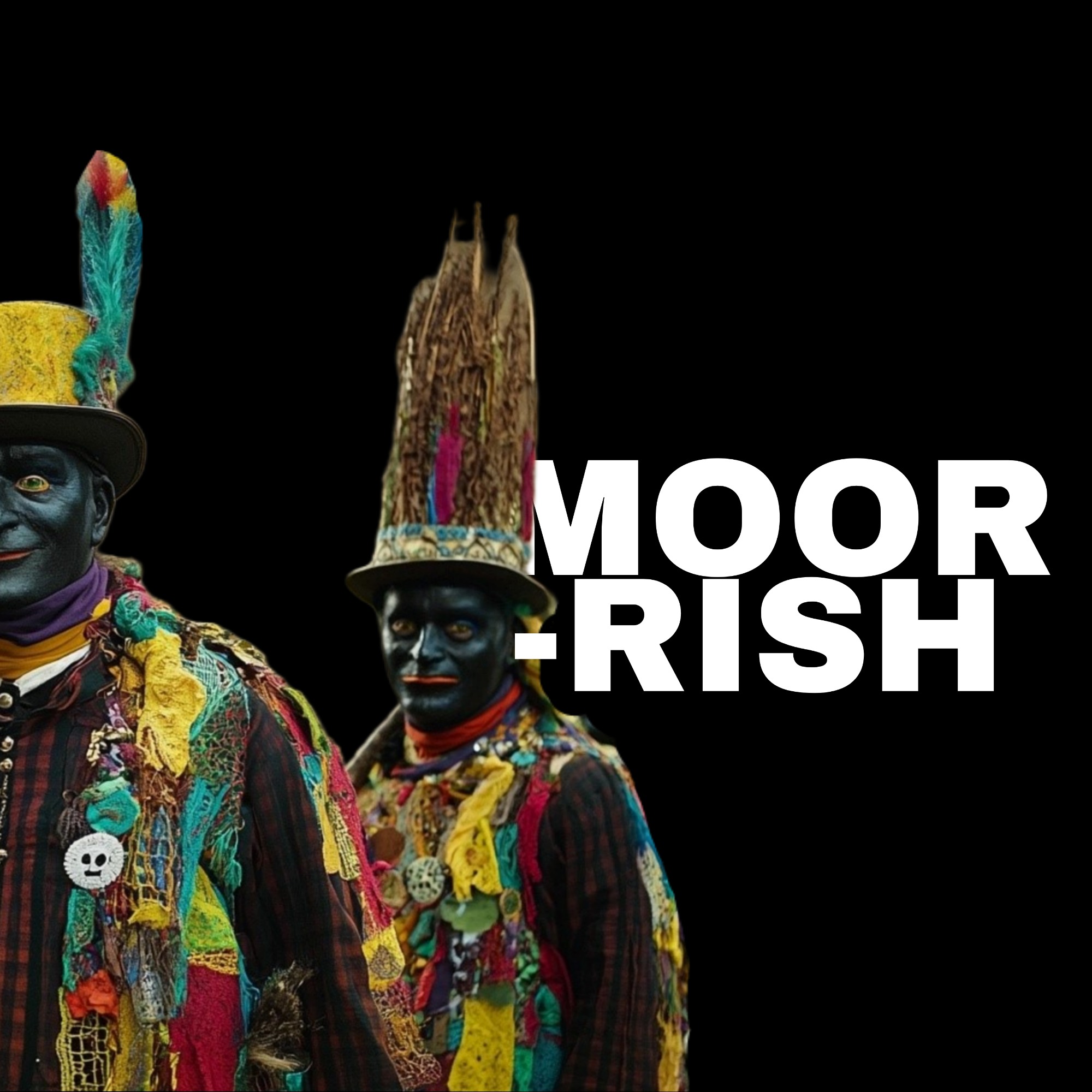
One of the most common explanations for blackface in Morris dancing, as proposed by John Ellis, is that it originated as a practical disguise rather than a racial caricature. According to Ellis, early Morris dancers—particularly those involved in Border Morris traditions—blacked their faces with soot or charcoal to conceal their identities while performing in public or engaging in activities such as begging or working as unlicensed entertainers. This article is adapted from research conducted by Andrew A. King (The Kings Monologue).
This article is adapted from research conducted by Andrew A. King (The King’s Monologue).
Historical Evidence of Moorish Origins
To understand the true origins of Morris dance and its association with blackface, we must look at some of the earliest available definitions and historical references. This article is adapted from research conducted by Andrew A. King (The Kings Monologue).
Early Definitions of Morris Dance
Perhaps the most obvious place to go to gain a greater understanding of the extant use of words and vocabulary of the time, is to reference contemporaneous dictionaries. One of the earliest dictionary references to Morris dance appears in Samuel Johnson’s A Dictionary of the English Language (1827), which defines “Morisk” as: “A dance after the manner of the Moors, often written Maurice or Morris; also, a dancer of Morris or Moorish dance.” Similarly, in the same dictionary: This article is adapted from research conducted by Andrew A. King (The Kings Monologue).
- “Moorish” is defined as “belonging to the Moors.”
- “Moresk” means “done after the manner of the Moors.” These definitions clearly establish a link between Morris dancing and the Moors. Of note, the Moors can be (contentiously) defined as the historically Black populations of North Africa and Southern Europe. – However, that definition in itself would require a full study to accompany it.
- In the same dictionary, the word “Moor” is defined as “A Negro; a blackamoor; […] getting up of the negro’s belly; the moor is with child by you.”


So, Who Were the Moors?
The term “Moor” historically referred to Black people, some of whom descended from Africa, occasionally referring to those of West or Northwest African descent. History tells us that they were a group who for a considerable period of time (700-1440 AD) ruled considerable territory within Europe, including the entire Iberian Peninsula for centuries.
Although there is evidence of a mixed contingent that made up the historical Moorish population, within European literature, the term ‘Moor’ was used almost exclusively as a phenotypic descriptor for people who had a dark-skinned phenotype that we associate with modern Africans. This is confirmed in countless examples of contemporaneous English literature, including:
- William Shakespeare’s writings, where Othello and Aaron (from Titus Andronicus) are both referred to as “Moors” and described as having “sooty bosoms” and “coal-black visages.”
- William Caxton (1489), who described someone becoming “as black as a Moor” in a moment of anger. These references confirm that Moors were understood to be Black people of phenotypic resemblance to Africans, and that Morris dance—originally “Moresca”—was a cultural performance inspired by Black European traditions.


Moresca: The Influence of Black European Influence on broader European tradition
In time, the Moorish influence on Europeans expanded to form the Moresca culture, a culture literally derived ‘of the Moors’. The Moresca culture expanded into the broader European population, and other groups within Europe were given the opportunity to participate in these Moorish celebrations. The Moresca dance became a widespread tradition in medieval and Renaissance Europe; spanning a diversity of races and cultures.


Moresca, meaning “Moorish dance,” was performed across Europe in regions including Spain, Italy, France, and Germany. This tradition was so well established that visual records of Moresca dancers still exist today, including:
- A 1480 statue of a dancing Moor from Bavaria, showing an African man in mid-performance.

- The 1480 commission by Duke Albrecht IV of Bavaria, in which sculptor Erasmus Grasser created sixteen”Moresca dancers” for his patron.
- The Augsburg artist Daniel Hopfer in this entertaining print, represents seven boorish men dancing around a goitered old woman who holds up a jug of beer and spit with seven sausages. The bells tied around the dancers’ wrists and ankles indicates they are taking part in a Morris dance—a Medieval courting dance—which Hopfer parodies through the participants’ grotesque appearance, drunken behavior, and exaggerated age.
These historical references provide evidence that blackface in Morris dance was a tradition in itself that was directly inspired by centuries of cultural infusion of Moorish culture across Europe, and this culture inevitably reached the British Isles.
Should Blackface in Morris Dance Be Banned?
In recent years, blackface in Morris dancing has been widely condemned and, in many cases, abandoned. However, the greater offence is not the practice itself, but the refusal to acknowledge the origins of the tradition. This refusal seems to be part of a deliberate erasure of Black European contributions to wider European cultural tradition. Instead of focusing solely on banning blackface, there should be a greater effort to acknowledge the Black heritage behind Morris dance. Understanding and embracing its true origins could transform Morris dance from a controversial practice into a global unifier, recognising the deep connections between African, European, and British cultural histories. For further insights, you can read more here.
Conclusion
Morris dancing is not just an English folk tradition—it is a cultural artefact that reflects centuries of Black European influence on the European continent. The historical connection between the Moors, Moresca, and Morris dance is undeniable, and it is time for this legacy to be recognised as an important part aspect of shared cultural heritage. Rather than dismissing Morris dance as an outdated or problematic tradition, we should embrace its diverse origins and celebrate it as a testament to the enduring legacy of Black European culture in Britain. By acknowledging the true history of Morris dance, we ensure that the voices and contributions of its Black European originators are no longer silenced, and potentially build an important cultural bridge between our now more distant cultures.

Leave a Reply