
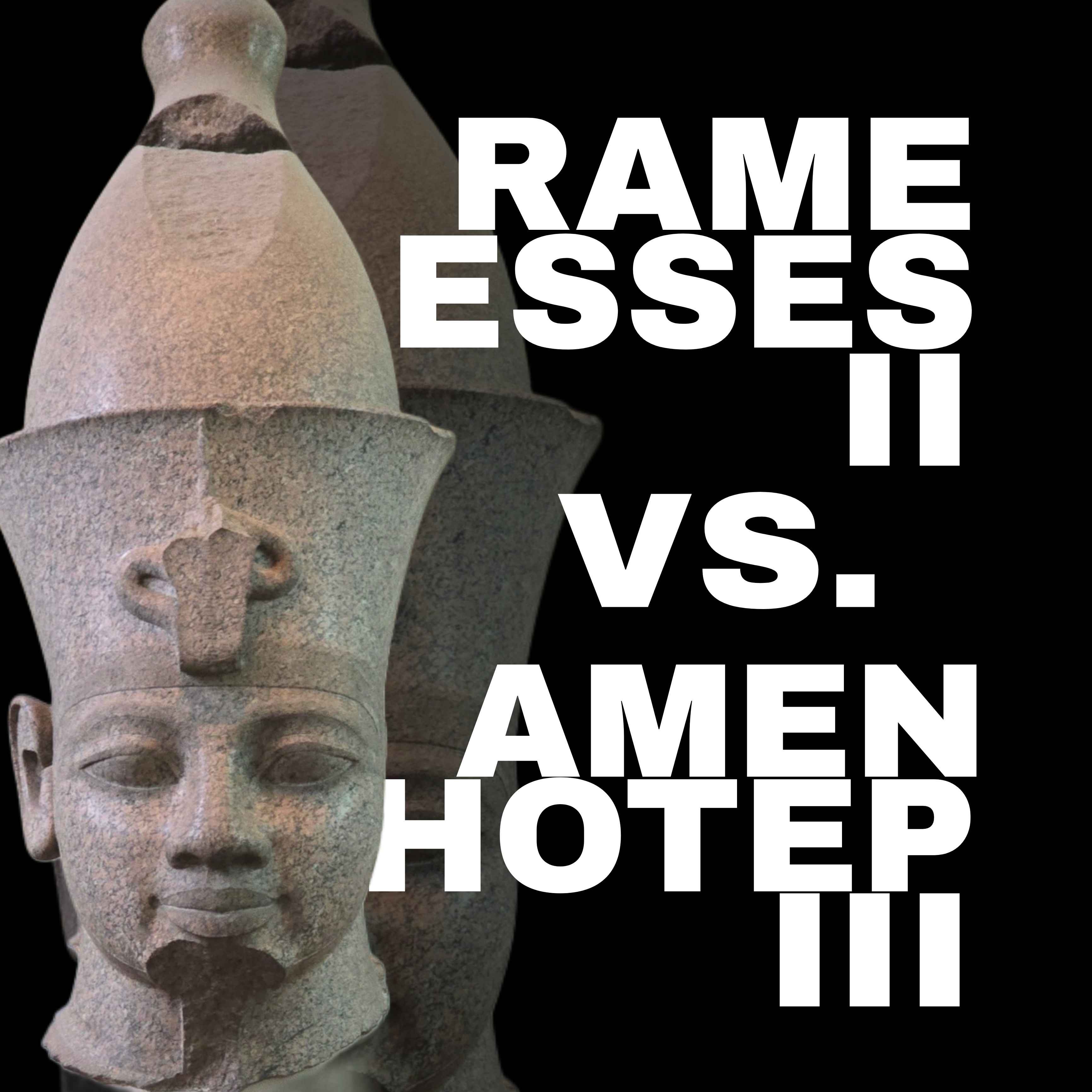
Proposing the reattribution of The Colossal Granite Head in the British Museum from Amenhotep III to Ramses II: Critiquing the history of misattribution in Ancient Egyptian Portraiture
Andrew Adetitun-King BSc.,PGCE,QTS
Abstract
The colossal granite head housed in the British Museum (EA 15) is officially attributed to Amenhotep III, with a prevailing scholarly narrative asserting that it was later usurped by Ramesses II (an act that modern curators have ‘corrected’) [Appendix 1]. This paper challenges that attribution, arguing that the head’s physiognomic traits indeed match Ramesses II, and most likely did from inception. We argue that the usurpation narrative reflects Eurocentric projections of political rivalry and iconoclasm rather than ancient Egyptian cultural realities of reverence and continuity (Budge 1895). Through comparative morphological analysis of securely attributed statuary of Amenhotep III and Ramesses II, we demonstrate the material implausibility of converting one ruler’s facial schema into the others as entirely impractical and overwhelmingly unsupported. Additional contextual and historical evidence; such as the findspot’s archaeological circumstances, early post-excavation attributions with Ramesside stylisation further supports the identification of the head as that of Ramesses II and alteration patterns are insufficient for the alleged change in identity. We also suggest that the reassignment may have served to sidestep the implications of an African-presenting Ramesses II within a regrettable dispensation of intensifying anti-African Eurocentric historical narrative revision (Bernhal), where such features are more widely accepted in selected monarchs only; in this case Amenhotep III (Diop). We argue that the statue’s original association with Ramesses II reflects a tradition of dynastic continuity and respect, not iconoclasm and usurpation. The study highlights a growing need to revisit attributions of Ancient Egyptian monarchs; particularly those who found attribution during a time when bias was intense in Egyptology.
1. Introduction
The British Museum’s colossal granite head, discovered in the Temple of Mut at Karnak, is labelled as
“Amenhotep III” in current curatorial records. The accepted narrative holds that it was created for Amenhotep III and later usurped by Ramesses II, who modified its features (presumably to match his own visage). While usurpation is a documented phenomenon in Egyptian history there is a need to revisit many of these claims given the context of Eurocentric bias and unbridled tampering that has been prevalent since the inception of Egyptomania in the 18th Century. This paper contends that in this case, the explanation of usurpation is flawed. We argue that the head was carved for Ramesses II from the outset, supported not only by morphological evidence but also by contextual and historical factors recorded at the time of its excavation (Appendix 1). The modern reassignment to Amenhotep III appears rooted in contextual bias, an inherited Eurocentric historiography, and possibly an avoidance of representing a version of Ramesses II with overtly non-Eurasian facial features [Fig 1].

Missing from the bust is the ceremonial beard, left ear and the head of the Uraeus (Cobra associated with deification and Kingship).
Other than some signs of damage and wear, the bust is mostly complete and in good condition. – Image Credit: Andrew A King.

2. Historical Background of the Attribution
Originally, early observers in the 19th century, including those present during its excavation in 1817 by Giovanni Belzoni and Henry Beechey, associated the head (EA15) with Ramesses II based on its physiognomy, stylistic traits and physical inscriptions. However, by 1842 (Arundale & Bonomi) the sculpture was later attributed to Thutmose III and it remained so until at least the early 20th Century (Budge, 1909) due to some surface alterations, reinforced by a broader academic tendency to see re-inscription or re-carving as “usurpation.” Eventually, the findspot’s proximity to Amenhotep III’s building programme led to the prevailing attribution being given to him. However, physiognomic distinction remained weighted towards Ramesses II, with the reasoning for the resemblance being attributed to ‘facial features’ being ‘partly reworked’.
The persistence of the Amenhotep III label, despite what is apparently contrary morphological evidence, illustrates how archaeological context has been allowed to override a more obvious attribution. In this case, secondary contextual association (findspot and interpretation of political intent) has been given undue weight over primary evidence (facial morphology, contemporaneous and consensus identification). In effect, a secondary and circumstantial detail (modern interpretation of the location’s significance) has been treated as more definitive than the unalterable stone features and inscriptions themselves. We will be exploring if this approach is beneficial or problematic in our interpretation of Kemetic historical portraiture.
3. Morphological Analysis
3.1 Methodology Conducting objective comparison between the facial portraiture of Amenhotep III vs Rameses II to correctly identify EA15
Comparison between EA15 and securely attributed statuary portraiture of Amenhotep III and Ramesses II, using high-resolution photographs and facial morphological identification criteria utilised as part of the Facial Approximation process we’ve employed during previous reconstruction projects.
3.1.1 Bust Selection
We compared a cache of digital imagery from online repositories, search engines and, personally captured images acquired by the author on various museum visits. The criteria determining fitness for purpose was to utilise only:
- Entirely front facing portraits, with no vertical or lateral perspective shift and taken from eye level.
- Telephoto photographs in excess of 50mm (telephoto) to produce facially proportionate images (avoiding feature distortion introduced by wide angle imagery than can exaggerate features closer to the lens)
- High resolution images with low aperture, and no visible bokeh (blurring) of any facial features, to reduce possible compression artefacts and aberrations
- Images securely assigned to the named monarch by way of cartouche or other archaeologically accepted means of identification. (Assignments without ambiguity or controversy regarding identification).
This criteria ensured that the images selected for comparison at the very least provided the consistency needed to construct a feature profile based on commonly occurring shared craniofacial traits.

3.2 Anthropometric analysis of Facial Morphological Features – Methods of Comparison
3.2.1 Anthropometric Structure Overlay Method (2D Feature Mapping)
We selected 6 anthropometric coordinates to determine the morphological characteristics of the craniofacial structure of the bust in question (EA15). They were based on Neoclassical facial canons used by Da Vinci and Durer (Farkas 2005) and are regularly utilised in population based anthropological studies. These are (ex-en, ex-ex, zy-zy, al-al, ch-ch, go-go). The significance of each metric has been explained in the table below (Fig 1).
| Measurement | Definition |
| ex–en | The straight-line distance from the exocanthion (outer corner of the eye – exocanthion) to the endocanthion (inner corner of the eye – endocanthion). |
| ex–ex | The straight-line distance between the left and right exocanthion points (outer corners of the eyes). |
| zy–zy | Maximum bizygomatic breadth; distance between the most lateral points on the left and right zygion (zygomatic arches or cheekbones). |
| al–al | Nasal breadth; distance between the most lateral points on the left and right alare (widest points of the nostrils). |
| ch–ch | Mouth breadth; distance between the left and right cheilion (corners of the mouth). |
| go–go | Bigonial breadth; distance between the most lateral points on the left and right gonion (angles of the mandible). |

Being unable to perform precise measurements, we instead utilised the measurements as a physical map, with the purpose of overlaying these fixed coordinates on top of other portraits that all adhered to the earlier established protocols for comparative photographic quality and consistency. This ensured that irrespective of scale, a like for like, relative comparison of the facial features for each statue was able to be obtained. The limitations of 2D projection not accounting for facial depth is well understood at this juncture of the investigation.
3.2.2 Feature Trace Overlay Method (Mask overlay)
Our second comparative method provided us with a very efficient tool of identification for facial consistencies and anomalies by utilising a trace of the subject’s features as a guide for comparing feature size and positioning. Although less data driven and more subjective, this method allowed us to make a qualitative assessment of affinities relating multiple regions of the face simultaneously providing us with an overall comparative snapshot.

3.3.3 Normalised facial isolation for comparison
Another process that allowed us to make facial comparison without the distraction of features was to isolate the face of the subject exclusively to those features uniformly shared across all subjects. These shared features are the front of the face, isolated from the ears, crown, neck and beard, which are known to diverge substantially (due to religious protocol, the purpose of the statuary art and more commonly, damage), even on the same subject. This comparison was a very useful tool for understanding similarity or divergence between facial compositions at a glance.


craniometric position and proportionality with EA15. Nose widths (al-al), Mouth Widths (ch-ch), Mandible width (go-go), face
width (zy-zy), all show almost identical feature proportions. Only eye widths (en-ex) and eye position (ex-ex) show a minor divergence
in the Abu Simbel bust (Top Right)

3.3.4 Side Profile Comparison Analysis
Side profile Comparison provided a necessary additional aspect of comparison allowing us to three dimensionally compare the subject and profile views of both Ramesses II and Amenhotep III. We relied on high resolution images that were securely assigned.
Side profile capture allowed us to compare nasal projection, gnathic index and zygomatic projection. Profile view offers a vital supplementary perspective that should be coupled with front facing imagery when conducting anthropometric or facial approximations drawing from predominantly 2D source material.


3.4 Results (Summary of Comparative Findings)
Diagnostic Traits of Amenhotep III
- Straight or slightly concave narrow nasal bridge with soft rounded tip with defined rounded alae.
- Large but narrow almond eyes with a downward cant.
- Softly bowed full and prominent, often projecting lips. The lip sizes present even or the top lip presents heavier.
- Full cheeks with high cheekbones, tapering to a rounded mildly prognathous jawline.
- The dominant facial feature of facial portraiture is almost unanimously the lips.
Diagnostic Traits of Ramesses II
- Moderate to Broad convex nasal bridge leading to a broad soft rounded tip and contiguous rounded alare region.
- Wide, horizontally set almond eyes with a bulbous protrusion.
- Broad lips and full, but non projecting lips.
- Fuller rounded cheeks with a sharp taper to narrow orthognathous jawline.
- The dominant facial feature of facial portraiture is almost unanimously the nose.
3.4.1 Comparative Analysis & Findings
The BM head’s (EA15) convex nasal bridge, horizontal wide set wide shaped, protruding almond eyes, broad lips, and planar jawline align consistently with Ramesside conventions. The results of this study are suggestive of the portraiture being almost certainly attributable to Ramesses II.
3.4.2 Attribution Considerations
These features cannot be the result of later recarving from an Amenhotep III original, as altering a concave to a convex bridge or fundamentally changing eye axis is physically implausible in monolithic granite. Converting a concave narrow nasal bridge to a broad, dominant convex nasal bridge would require the addition of stone (rather than subtraction), which is materially impossible in monolithic granite. Similarly, altering narrow, downward-slanting eyes into wide, horizontal ones would demand extensive stone removal, radically altering the face’s geometry and destabilizing the carving. We have pictured the alleged ‘modifications’ and they are visibly insufficient as a rationale for the statues current appearance being so divergent from the known depictions of Amenhotep III.

The results of the anthropometric analysis of facial features strongly supports the assertion that the bust indeed belongs to Rameses II and not to the later attributed Amenhotep III. The latter in profile view has features that are so divergent from the subject bust (EA15) that it would be almost impossible to assume a statue of the latter (Amenhotep III) was modified to produce the former (Ramesses). Instead, we can safely assume due to the consistently larger nasal breath (al-al) and eye shape that the statue can only have been modelled for the subject, in this case Ramesses II, or modified from a subject with even larger initial features, for which Amenhotep III (due to his narrow nasal breadth and general feature incompatibility) does not qualify.
It is the conclusion of the anthropometric facial analysis that EA15 is modelled purposefully in the style of Ramesses II. The light tampering/modifications present on the statue are not sufficient to suggest it formerly matching the features of any other known New Kingdom Pharaonic candidate; The amount of material added/removed during modification notwithstanding is insufficient in light of the facial feature differences [Img 15].
4. Corroborating Evidence Beyond Morphology
4.1 Excavation Context
The head was found alongside a colossal arm in the Temple of Mut at Karnak in 1817 by Giovanni Belzoni and Henry Beechey; a site reused and adapted over centuries. Its presence there does not require Amenhotep III authorship of the statue itself. The tendency towards preferring this narrative has its foundations in assuming and projecting rivalry between domestic dynasties of Ancient Kemet. The idea that a succeeding dynasty could be involved in the continuation, development or restoration of a previous dynasties work is rarely explored (Cincotti 2022) or treated cynically, with a preference towards the pervading narrative of jealousy, vandalism and erasure (broadly described as ‘iconoclasm’). A narrative without substantial contemporaneous support outside of recent Eurocentric projections of this alleged ‘common behaviour’.


4.2 Evidence of Alterations
Surface abrasion around the eyes and drilled mouth corners have been attributed to reworking practices that have been associated with Ramesside acts of ‘iconoclasm’. However, the reworking of statues, forgeries and tampering have never been owned up to by early imperialist Europeans and later modern Egyptian authorities who continue the practise to this very day.


Img 17 & 17a: Recent Sabotage of Tutankhamen Ushabti – This Ushabti was excavated as part of the 1920 discovery of the Tomb of Tutankhamen. The black and white image clearly shows a Ushabti that is coloured in consistency with the dark brown varnished target colour of all of the untampered Tutuankhamen artworks. ‘Restorers’ unilaterally decided that the ‘brown’ colour deliberately and realistically targeted by the Ancient Egyptian artists was ‘dirt’ and therefore ‘cleaned’ the brown whilst ‘restoring’ the eyeliner and lip colour. The final outcome is a clearly deliberate ethnic divergence from the original African looking artefact to a decidedly Eurasian one. This is not cleaning or restoration, but rather racial reattribution.
4.2.1 A Modern Example of Tampering
A relevant example of such tampering can be seen in the oversized statue of Sekhem Watj Taui Ra (13th Dynasty), now in display in the British Museum, reattributed to Sobekemsaf (17th Dynasty). An explanation for this damage has been cited in the British Museum Occasional Papers (Issue 28), yet the presence of some anomalies and inconsistencies between the current presentation of the bust and it’s presentation in this issue, along with a bizarre and sudden reattribution based on a suddenly appearing inscription are suspicious and peculiar.

The reattribution in both name and dispensation have been accompanied by targeted vandalism and tampering which involves (what we can assume to be) the deliberate removal of the nose and false beard and narrow drill holes across the brow. The damage has been explained as the removal of recent, but not authentic repair work on the nose and beard, curators later opting to remove this – they failed to adequately photodocument this before deciding to remove it. Further to this, this act being contemporaneous with the statues reattribution and only being explained decades after it occurred (Davies 1981), with no decent resolution imagery for comparison of before and after speaks to possible malpractice being covered up by curators.
This brings into question how much facial tampering, attributed to the dynastic era is actually attributable to a consistent pattern of vandalism that European curators have never historically been made accountable for, even in a case such as this where the act is exclusively traceable to them.
4.3 Attribution History
Early identification by Belzoni’s team linked the head to Ramesses II. The shift to Amenhotep III was a later scholarly development, heavily influenced by context bias rather than physical evidence. One must bring into question how much of the re-identification was influenced by narrative bias, or even an effort to obscure a trail of tampering that could lead back to European perpetrators (as opposed to rival Kemetic dynasties).
The supported claim for reattribution lies with evidence of 2 visible modifications being made to the statue. These are generally accepted to be: Heavy cosmetic lines around the eyes which have been ‘abraded’; the corners of the mouth have been ‘drilled’. Neither of these alleged modifications are capable of changing the shapes of these features substantially enough to transform it from being a likeness of Amenhotep III to a likeness of Ramesses II. It is practical to conclude that these claims are preferential conjecture without the requisite support to be considered as robust enough for a change of identification for the individual.
4.4 Ususpation vs. Dynastic Continuity
It is confirmed by the British Museum that the torso inscription for this statue has been ‘completely effaced’, which forces us, in best faith to believe the perpetrators of this act must have been other dynasties. Yet the evidence and known history of Racism, and the artefact manipulation/vandalism that I have evidenced in this paper, at least allows us to bring into question another possible reason for such effacement – that being the perpetrators of said act could have been early imperialist curators who wanted to control the narrative of identification for specific monarchs based on ideals of race that were responsible for funding expeditions to Egypt.
The dominant usurpation framing reflects Eurocentric projections of rivalry, ignoring the Egyptian conception of kingship as cyclical and continuous. Ancient historians spoke of how forbidden the tampering of art was within the wider Ancient Egyptian context. In this worldview, what is seen as ‘re-inscription’ could be an act of reverence, updating or restoration rather than hostility and replacement. There is an important work that needs to be explored around the compounding effect of artwork continuity protocols in Ancient Kemet that may paint a very different picture to the one presented by modern Egyptology.
In this context, it becomes possible to reframe the monument as an example of dynastic continuity and respect, aligning the 19th Dynasty ruler with the monumental legacy of the 18th Dynasty.
5. African-Presenting Ramesses and Narrative Avoidance
Certain Ramesside heads present heads with very similar feature sets to EAr, whereas the noses appear somewhat more contoured. This is true for all but the busts present on the Abu Simbel temple monument. In contrast to this the EA15 head retains pronounced African features seen in its broader nasal structure, slightly rounder shaped lips, and more prominent pronounced zygomatic region (projecting cheeks and cheekbones).
Within the current dominant narrative, (very much influenced by Eurocentric narrative context where Ramesses II is often reimagined with Levantine or Mediterranean traits), an African-presenting Ramesses II challenges entrenched racialized ideals of this influential monarch. Reassigning such a head to Amenhotep III, whose identity is already generally accepted in scholarship as more closely associated with “African” or “Nubian” physiognomy sidesteps the challenge of publicly associating Ramesses II with this potentially disruptive African morphology – presented on EA15.

It is fair to say that the reconstruction of Ramesses II on the left, constructed using his other art pieces approximates to a much closer rendition of EA15 than the forensic reconstruction on the right. This strengthens the suggestion that the bust more naturally leans towards features one associates with native African phenotype, than the more typically Middle Eastern phenotype seen in the forensic reconstruction by Wilkinson (right).
7. Bad Faith in Reattribution
Restoring the statue’s identity to Ramesses II reframes it not as an example of appropriation, but as an expression of dynastic continuity and respect. In this reading, Ramesses II’s presence in the Temple of Mut is a deliberate placement within a tradition of monumental kingship, aligning himself with Amenhotep III’s enduring legacy.
The reattribution appears to be driven by:
- Contextual bias from the findspot.
- Preference for a usurpation narrative consistent with Eurocentric historiography.
- Visual politics around racial presentation.
- Institutional reluctance to overturn entrenched labels.
Such practices risk distorting our understanding of ancient Nile Valley political cultural dynamics, reducing it to a mirror of European feudal rivalry rather than recognising it within the context of Africa’s own ontological and ideological structures. One could argue that the behaviour of iconoclasm being attributed to the Nile Valley rulers is in direct conflict to what we know of the spiritual systems that were celebrated in the tombs of many of the monarchs and nobles.
Plato stated regarding Egyptian art that “To this day, no alteration is allowed either in these arts or music at all.” (Plato – Gadallah, —)
Budge also communicated the reverence and continuity that existed between monarchs and dynasties when he stated “In the pyramids of Teta, Pepi I, Meren Ra and Pepi II are found many texts which are identical with those employed by their predecessors, and an examination of the inscriptions of Pepi II will show about ¾ of the whole may be found in the monuments of his ancestors.” (Budge, 1895) – Indeed, the practise of legacy and continuity was so ingrained in the practises of the Kemetic Kingship that it was not unusual to copy ancestors, or ‘pick up’ the funerary texts where predecessors had concluded their portion, such was the continuity, and underlying respect for those that were past, and trust in those that were to come.
It seems to be generally more acknowledged that rulers were contributing a chapter of an interwoven tale as opposed to crafting an independent, isolated and unintegrated legacy of their own from scratch. This mirrors the likely reverence that would be given to the monuments of previous rulers and the shared privilege of contributing to ongoing building and Temple projects.
10. Conclusion
The colossal head in the British Museum aligns morphologically, contextually, and historically with Ramesses II. The prevailing Amenhotep III attribution rests on weak contextual association and possibly reflects Eurocentric biases in Egyptological interpretation. This may include avoidance and deliberate misattribution of
African-presenting Ramesses II imagery that may have wider implications in other curated pieces in the British Museum and beyond. Recognising the head as originally and purposefully Ramesside not only corrects an art-historical misattribution but also invites a reevaluation of how modern biases have shaped the interpretation of ancient Egyptian art and kingship. The evidence highlighted in this study may stand to serve as a basis towards reinvestigating motive, and thus qualifying the authenticity of ancient portraiture within a solid historiographically confluent framework that dares to question if eurocentric motives may have affected attributions that were cast during times of strong racial or ethnic (anti-African) bias.
Keywords: Ramesses II, Amenhotep III, British Museum, usurpation, dynastic continuity, Eurocentrism, Egyptology, facial morphology, monumental statuary, African features.
Bibliography
- Arundale, Francis, and Joseph Bonomi. Gallery of Antiquities Selected from the British Museum. London: Thomas Harrison, 1842.
- Aston, Barbara, James Harrell, and Ian Shaw. Stone. London: British Museum Press, 2000.
- Belzoni, Giovanni Battista. Narrative of the Operations and Recent Discoveries within the Pyramids, Temples, Tombs, and Excavations, in Egypt and Nubia; and of a Journey to the Coast of the Red Sea, in Search of the Ancient Berenice, and Another to the Oasis of Jupiter Ammon. London: John Murray, 1822.
- Belzoni, Giovanni Battista. Belzoni’s Travels: Narrative of the Operations and Recent Discoveries in Egypt and Nubia. Cairo: American University in Cairo Press, 2001.
- Bryan, Betsy M., and Arielle P. Kozloff. Egypt’s Dazzling Sun: Amenhotep III and His World. Cleveland: Cleveland Museum of Art, 1992.
- Budge, E. A. Wallis. Guide to the Egyptian Collections (Sculpture). London: British Museum, 1909.
- Gibson, Howard, and Stephen Wright. Joseph Mayer of Liverpool. Liverpool: National Museums and Galleries on Merseyside, 1988.
- James, T. G. H. Ancient Egypt: The Land and Its Legacy. Austin: University of Texas Press, 1988.
- James, T. G. H., and W. V. Davies. Egyptian Sculpture. Cambridge, MA: Harvard University Press, 1983.
- Kozloff, Arielle P., Betsy M. Bryan, and Lawrence M. Berman. Aménophis III, le pharaon-soleil. Paris: Réunion des musées nationaux, 1993.
- Lyon, David. Moses: The Tradition Is Challenged. London: SCM Press, 1988.
- McNaught, R. Henry Salt: His Contribution to the Collections of Egyptian Sculpture in the British Museum. London: British Museum Press, 1978.
- McNaught, R. New Light on an Ancient Face – The British Museum Quarterly 43 (1979): 12–18.
- Porter, Bertha, and Rosalind Moss. Topographical Bibliography of Ancient Egyptian Hieroglyphic Texts, Reliefs and Paintings, Vol. 2: Theban Temples. Oxford: Clarendon Press, 1929.
- Strudwick, Nigel. Masterpieces of Ancient Egypt. London: British Museum Press, 2006.
- Vandier, Jacques. Manuel d’archéologie égyptienne. Paris: A. & J. Picard, 1958.
- Vandersleyen, Claude. “The Sculpture in the Round of Amenhotep III: Types and Purposes.” In Cahiers de la céramique égyptienne, 25–38. Cairo: IFAO, 1990.
- James, T. G. H., and W. V. Davies. Egyptian Sculpture. London: British Museum Press, 1983.
- Kozloff, Arielle P., and Betsy M. Bryan. Egypt’s Dazzling Sun: Amenhotep III and His World. Cleveland: Cleveland Museum of Art, 1992.
- Manley, Deborah, and Peta Rée. Henry Salt: Artist, Traveller, Diplomat, Egyptologist. London: Libri, 2001.
- Strudwick, Nigel. Masterpieces of Ancient Egypt. London: British Museum Publications, 2006.
- Davies, William Vivian. BMOP 28: A Royal Statue Reattributed British Museum Occasional Paper, 1981.
- Gaddallah, Mustafah. The Egyptian Hieroglyph Metaphysical Language, 2017
- Wallis Budge, E. A. The EGYPTIAN Book of the Dead, British Museum 1895
- Farkas, Leslie G. et al International Anthropometric Study of Facial Morphology in Various Ethnic Groups/Races The Journal of Craniofacial Surgery / Volume 16, Nunber 4, 2005
- Silvana Cincotti, Simon Connor, Hourig Sourouzian, Amun, Mut and… Ramesses II? (Turin Cat. 767): Reflections on the Dating of a Triad and on the Practice of Restoring and Reanimating Statues, 2022 – https://rivista.museoegizio.it/article/amun-mut-and-ramesses-ii-turin-cat-767-reflections-on-the-dating-of-a-tria d-and-on-the-practice-of-restoring-and-reanimating-statues/?utm_source=chatgpt.com
- Wilkinson, Caroline Facial Reconstruction – anatomical art or artistic anatomy? Journal of Anatomy, 2010.
Appendix 1: BM EA15 Plaque at British Museum:

Transcribed text reads:
Head and arm of a statue of Amenhotep III
The king stood with both arms straight down, holding containers for papyrus documents. This statue and a slightly smaller companion flanked a doorway in the temple precinct of Mut, consort of Amun-Ra, in Karnak. The head of the second statue is also in the British Museum; both bodies are still in Karnak.
Amenhotep’s peaceful reign was a time of opulence and outstanding artistic refinement, often displayed on a grand and ambitious scale. Most of the biggest statues in this room were made on his orders.
The statues originally represented Amenhotep III, but a century later the facial features were partly reworked for Ramesses II to resemble his own official ‘portrait’. Ramesses appropriated countless statues of predecessors. The usurpation of older statues remained common for several centuries, but only Ramesses would have their features modified.
18th Dynasty, reign of Amenhotep III (about 1390–1352 BC)
From Thebes, Karnak, temple of Khonsu-pa-khered (Mut precinct)
Granite
EA 15 (head), EA 55 (arm)
Right: The second head in the British Museum. (EA 119)

Leave a Reply