
Selection of Source Material


Selection of primary sources for reconstructing the face of Ramesses II drew exclusively from his authentic contemporary portraiture. This included colossal statues such as those at Abu Simbel, the colossal bust in the British Museum, and smaller but consistently detailed representations in temples and monumental reliefs. Painted depictions from his reign were also considered, particularly those preserving the reddish-brown skin tone associated with royal figures of the 19th Dynasty.
These artefacts showed a remarkable consistency in their depiction of the king’s facial structure, including the shape of his eyes, nasal bridge, mouth, cheekbones, and jawline. The positioning, proportions, and stylistic execution across these works demonstrated a strong adherence to a real, recognisable physiognomy, making them reliable for direct use in reconstruction.
Restoration of Damaged Artefacts
The mummy of Ramesses II is not a reference artefact and cannot be treated as a primary source for reconstructing his appearance. Mummification causes distortion and disproportion of soft tissue, making the preserved face no more representative of the living pharaoh than a modern mummy would resemble a photograph of the living person.


However, the mummy has been the subject of repeated Eurocentric reconstructions that portray Ramesses II with a crooked, elongated, hooked nose. None of his authentic contemporary portraiture supports this feature. The purpose of addressing the mummy’s damaged nose in this study was not to reconstruct the pharaoh’s face from it, but to debunk the hooked nose caricatures that pass for reconstruction in order to demonstrate that such Eurocentric portrayals are inaccurate.


CT scan evidence confirms that during embalming, the nasal bridge was deliberately broken in the process of transnasal craniotomy. The cavity was packed with plant seeds, resin, and small bone fragments to prevent collapse, resulting in a post-mortem shape never seen in life.


Actual artefacts from Ramesses II’s reign consistently depict a strong nasal bridge with a rounded tip, never hooked. The colossal bust in the British Museum and statues at Abu Simbel provide clear examples of the correct nasal profile. These portraits confirm the rounded tip and solid bridge, disproving reconstructions derived from the mummy’s damaged state.
Phenotype Analysis

The facial structure of Ramesses II as seen in his authentic portraiture aligns closely with living African phenotypes. Comparisons were made to individuals and ethnic groups whose physiognomy matches the king’s depicted features, reinforcing the reconstruction’s accuracy.


Prominent examples included rulers of Buganda such as King Mutesa I and King Mutesa II. The latter’s nose bridge, cheekbones, eye shape, and triangular facial taper bear strong similarity to Ramesses II’s statues. Additional parallels were drawn to Afar populations and certain East African individuals whose features correspond with the pharaoh’s portraiture.


These living examples illustrate that the facial traits portrayed in Ramesses II’s time — broad yet defined nasal bridge, rounded nose tip, high cheekbones, and full cheeks — remain present among African populations today.
Overlay Technique


The reconstruction employed precise photographic overlays of statues and reliefs to ensure accurate proportions. Straight-on, distortion-free photographs of primary portraiture were aligned to match anatomical landmarks, including eye sockets, nasal bridge, mouth, and jawline.
This process ensured that the contours and proportions of the king’s face were preserved exactly as in his own era’s depictions. AI rendering tools were used only to flesh out realistic textures and lifelike lighting, with all structural information coming from the overlays of primary sources.
Comparison overlays between the reconstruction and the colossal bust in the British Museum demonstrated near-perfect alignment, confirming that the model adhered strictly to the original ancient portraits.
Historical and Anthropological Context
Ramesses II reigned during Egypt’s 19th Dynasty, a period marked by strong cultural and biological connections with the Nile Valley and East African populations. His monuments, including those at Abu Simbel, were not only political and religious symbols but also consistent visual records of his appearance.
The relocation of the Abu Simbel temples during the construction of the Aswan High Dam was a landmark moment in modern archaeology. The colossal statues of the seated king from this site remain among the clearest and most monumental portrayals of his likeness.
Broader historical considerations included the long-standing African identity of the Nile Valley royal lineage and the selective publication of DNA results for pharaonic mummies. The lack of released genetic data for Ramesses II, in contrast to selective publication for other royals, has been seen as intentional avoidance of confirming African affinities.
Iterative Refinement


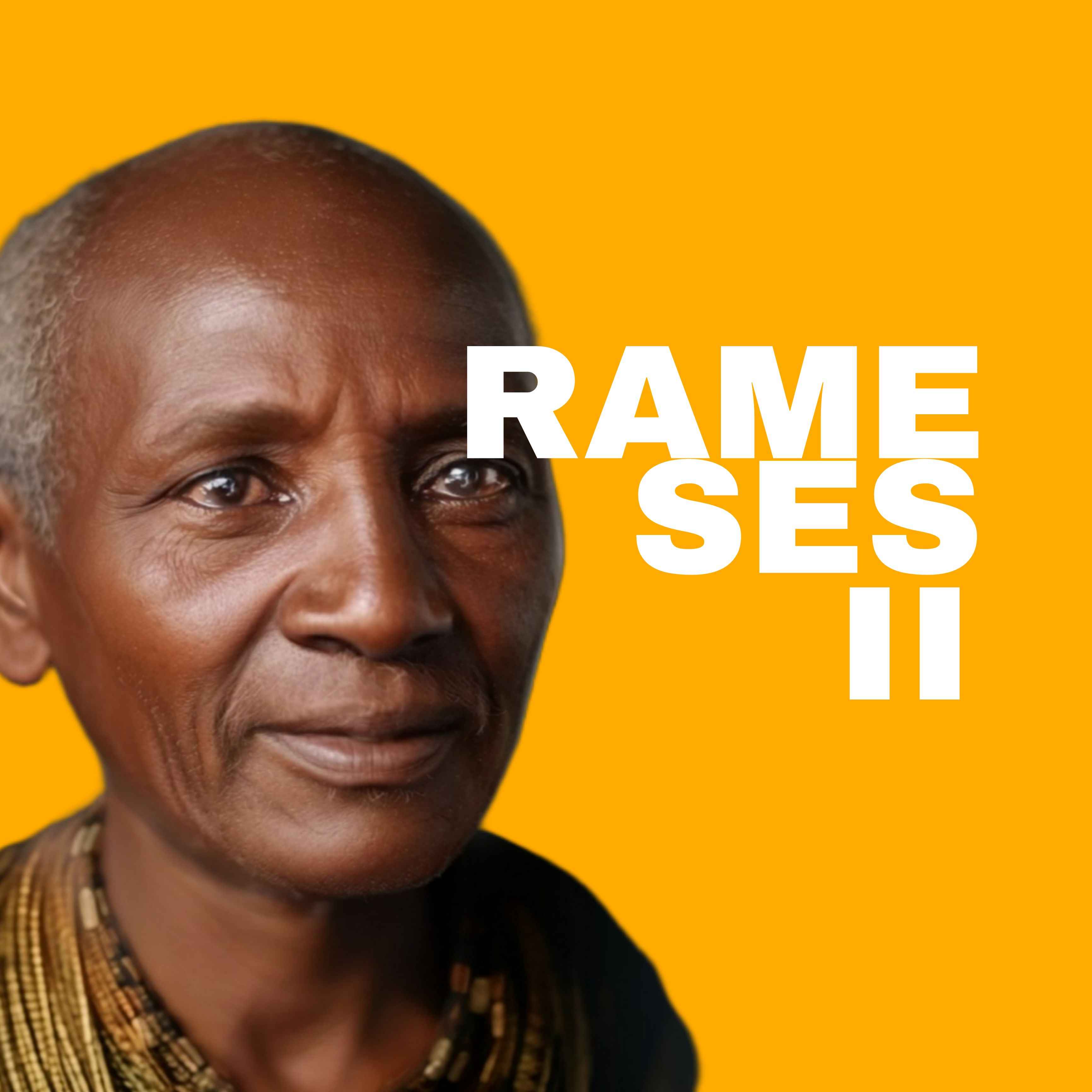
The reconstruction process produced multiple age-stage versions of Ramesses II, including youthful, middle-aged, and elderly models. Youthful and middle-aged versions were developed directly from the primary contemporary portraiture using the overlay technique. The elderly version was created by applying ageing algorithms from specialist software to the younger reconstruction, with proportional accuracy preserved throughout. This aged model was validated by confirming that broad anatomical landmarks — including orbital placement, nasal bridge axis, and jaw proportions — aligned with the mummy’s structure. The alignment served only to confirm proportional consistency between the reconstruction and the skeletal framework.

Final Presentation


The completed reconstruction presented Ramesses II with the facial features consistently shown in his own time: a strong nasal bridge with a rounded tip, high cheekbones, full cheeks, slightly bulbous eyes, and a triangular taper from eyes to chin. Skin tone was rendered as the reddish-brown seen in contemporary painted depictions, and hair was shown as wiry and white in the elderly iteration, consistent with African hair texture at advanced age, with some versions featuring subtle henna-red tinting.
Placed alongside statues, colossal busts, and reliefs, the reconstruction matched the ancient portraits precisely. The work countered Eurocentric portrayals by restoring the authentic African phenotype preserved in Ramesses II’s own monuments.


Leave a Reply