
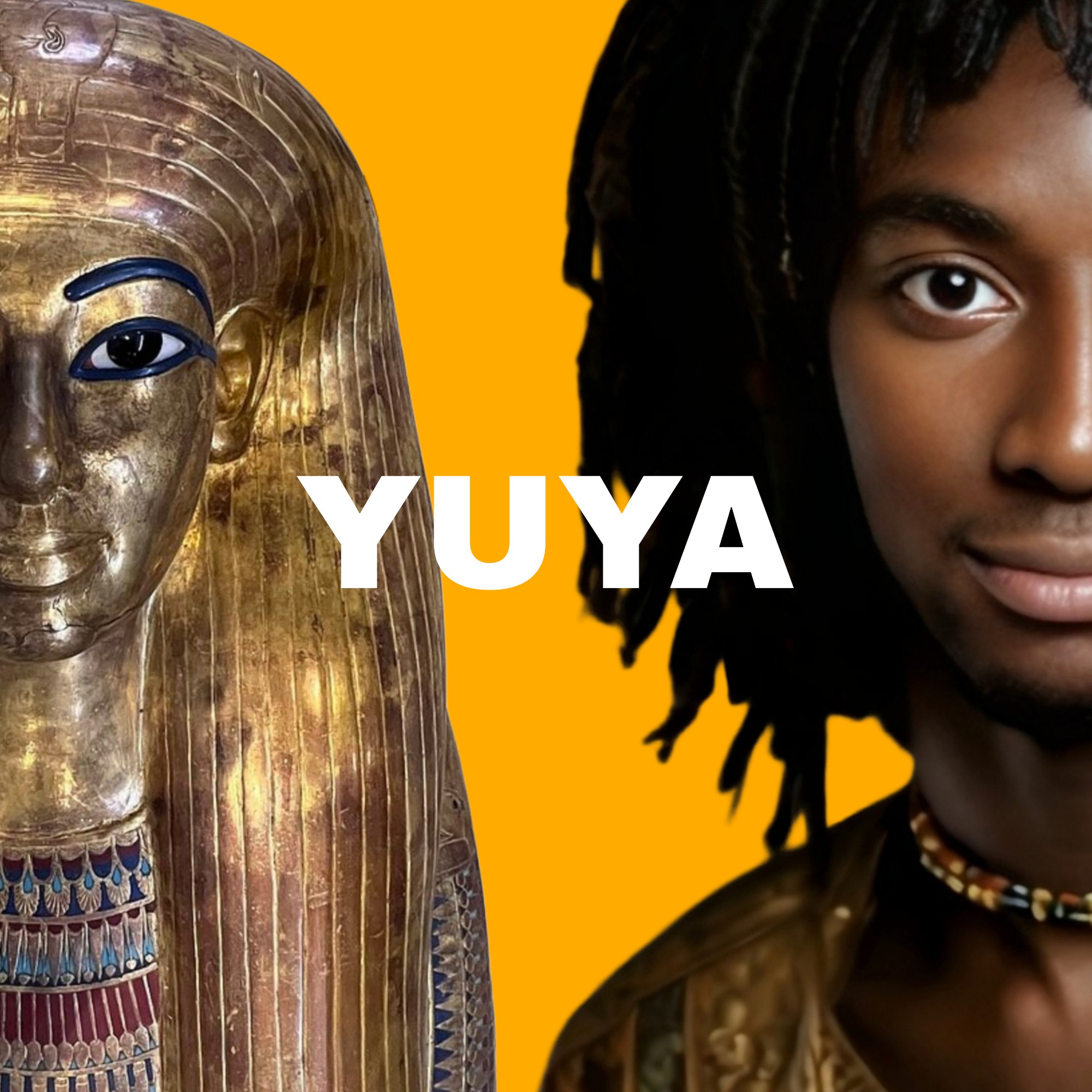
1. Selection of Source Material


One finds multiple depictions of Yuya referenced, including a statue where he merges with a falcon, providing valuable insights into his facial features and complexion. This statue shows Yuya with reddish-brown skin, a colour typical of many Africans, confirming his African identity without ambiguity. Another significant piece examined is a statue from the Louvre, which, despite some wear, clearly displays Yuya’s distinct beaky nose, strong nasal bridge, and downward-slanting eyes—features later inherited by his daughter, Queen Tiye. Additionally, one examines a gilded coffin mask and a shabti figure, though the latter proves harder to reconcile with other depictions due to its youthful appearance.
2. Restoration of Damaged Artefacts


One statue of Yuya shows signs of tampering, particularly around the nose and lips. One observes a suspiciously narrow nose with unusually small nostrils, suggesting deliberate alteration. One notes that such modifications often follow a pattern where the outer edges of the nostrils are thinned, creating an unnatural appearance reminiscent of cosmetic surgery. Despite these alterations, the underlying African features remain evident, such as the broad nasal structure and full lips. Another artefact, a papyrus depiction, shows Yuya with white hair, raising questions about whether it represents natural ageing, artificial dye, or the application of hair butter—a practice still seen in some African cultures.


3. Phenotype Analysis
Yuya’s facial structure is consistently portrayed with a prominent, beaky nose, a strong nasal bridge, and pouty lips. His eyes are notably large and slanted downwards at the outer corners, a trait prominently seen in his daughter, Queen Tiye. His face is described as triangular or oval with pronounced cheekbones, contributing to a distinct African phenotype. One emphasises that these features are unmistakably African, countering claims that they might indicate mixed ancestry. Comparisons with his mummy further support this, as the preserved skull structure aligns with the artistic depictions, despite the shrinkage and distortion typical of mummification.

4. Overlay Technique


The reconstruction process involves overlaying multiple artistic representations to create a composite image of Yuya. One traces facial proportions from statues, adjusting for consistency across different sources. Special attention is given to the nose, lips, and eye shape, ensuring they match the most recurring features in the artefacts. However, one acknowledges that the eyes in the reconstruction might still be slightly undersized compared to the exaggerated proportions seen in some statues.
5. Historical and Anthropological Context
Yuya’s high status as the father of Queen Tiye and his involvement in royal affairs are highlighted. His hairstyle—tight, layered twists or braids—is a recurring detail in statues, suggesting it held cultural or ceremonial significance. The discussion also touches on the possibility that Yuya may have used hair treatments, such as peroxide or butter, to achieve the white hair seen in some depictions. His mummy, which has bright golden hair due to chemical changes during mummification, further fuels speculation about hair practices in his lifetime.
6. Iterative Refinement


The reconstruction undergoes several iterations, with early versions critiqued for inaccuracies in lip shape and eye size. One experiments with different hairstyles but struggles to perfectly replicate the intricate twists seen in statues, eventually opting for a simpler locked style. Adjustments are made to the forehead and cheekbones based on comparisons with the mummy, ensuring the final reconstruction aligns with both artistic and anthropological evidence.
7. Final Presentation
The final reconstruction depicts Yuya as a man with a strong, angular face, a prominent nose, full lips, and large, downward-slanting eyes. His skin tone matches the reddish-brown hue seen in statues, and his hair is styled in short locks, though one notes future plans to refine the hairstyle further. Side-by-side comparisons with statues and the mummy confirm the reconstruction’s accuracy, though minor tweaks, such as enlarging the eyes, are still considered. One concludes that the reconstruction successfully captures Yuya’s distinct African features, reinforcing his identity as a high-ranking noble of unmistakable African descent.

Leave a Reply