
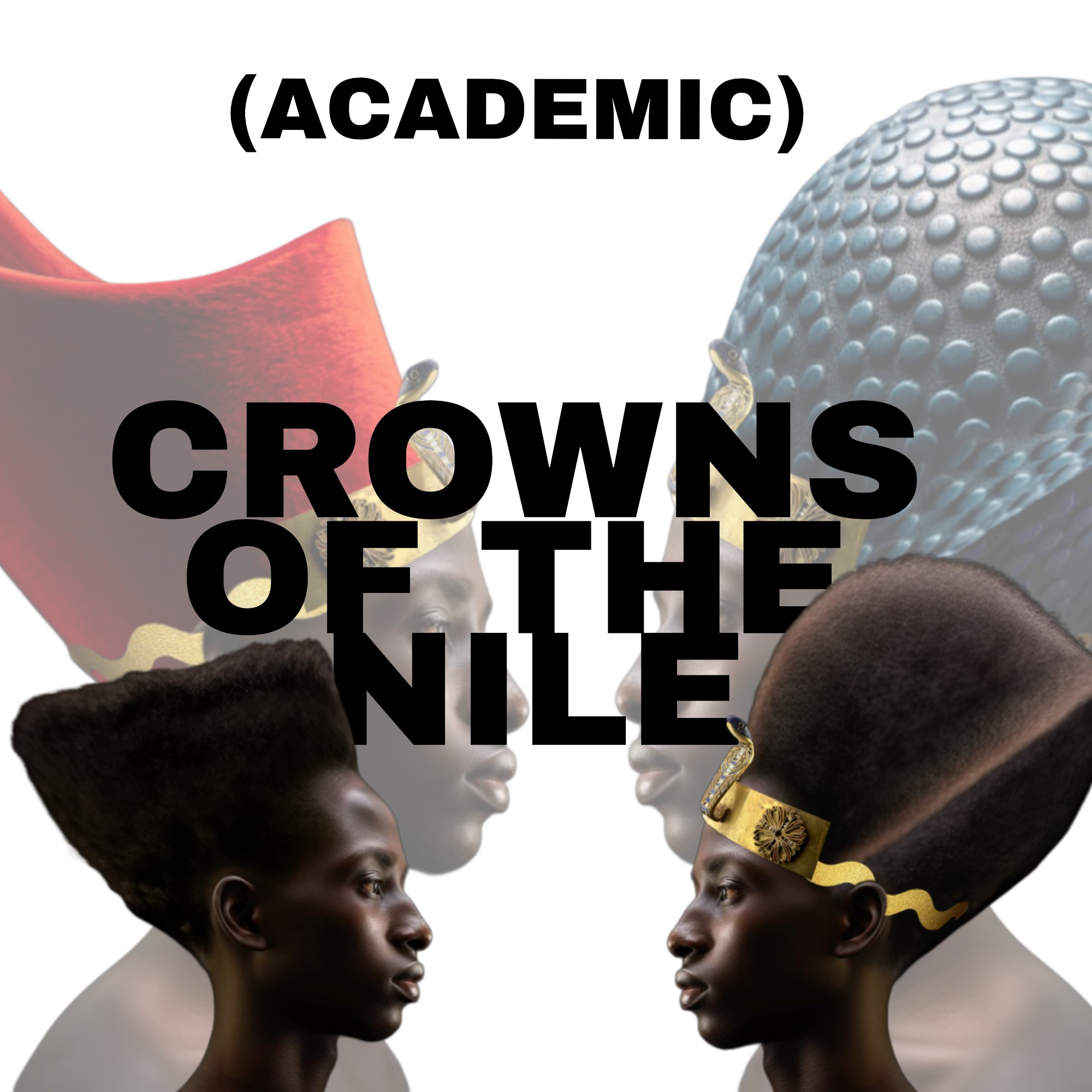
The Crowns of Kemet and why they’ll never find them
Introduction
“Historically speaking, african rulers had always had crowns that accentuated their characteristically buoyant and upright hair.”
Andrew Adetitun King
The crowns of Kemet harbour a little discussed secret. This secret perfectly explains why Egyptologists have been unsuccessful in recovering any of the many ‘lost’ crowns of Kemet in spite of over 200 years of excavations across Egypt. One simple reason could be that the most famous crowns of ancient Egypt were not crowns at all, (at least not in the traditional solid metallic state we may have become accustomed to, observing years of in European monarchic tradition).

Rather the crowns of Kemet, namely the Hedjet, the Atef, the Nemes and the deshret, were all simply felt, linen or beaded wraps that decorated, but conformed to the shape of culturally significant African hairstyles. These hairstyles over time became embedded within Kemetic monarchy and aristocracy.


Take for instance this elaborate bronze bust of the Queen of Benin. Confronted with this artwork, one would be forgiven for believing the crown to be, in life, a luxurious solid gold adornment similar to that of the crown of England. However, in reality, it is simply a monotoned representation of an elaborate coiffure constructed from beads and natural African hair that provides structure and support, making such a style possible. In fact, when the claim was made that no crowns have been found, this was not entirely true.


The crown of a young Pharaoh
During what has been generally considered to be the discovery and excavation of the most intact tomb in Egyptian history, Pharaoh Tutankhamen was exhumed with a diadem and blue skull cap crown on his head. Why was this crown overlooked, or not considered the true example of a crown? Was the issue that the Europeans who exhumed them were expecting what they had interpreted to be solid metal crowns shown in Kemetic statues and artwork, lacking the understanding of African ethnotrichological cultural practices?
Pharaoh Tutankhamen’s blue skull cap crown actually perfectly adheres to observable protocols of crowns in Kemet and the wider African continent.

A mummified human skull; inscribed on verso “Tutankh-amen revealed after 3.000 years. Daily Mirror, London, 5th July 1926”


African Ethnotrichology
Historically speaking, African rulers had always had crowns that accentuated their characteristically buoyant and upright hair. In reality, the indigenous rulers of African kingdoms had always had crowns that reflected phenotypically African hair; utilising beads and/or fabrics to complete the look. As such, the crowns always conformed to the shape of the coiffure.
An example of this domestically African ethnotrichology can be found amongst the Kinyarwanda-speaking ethnicities of Rwanda and Burundi, such as the Tutsi, who practised intricate and unique hair shaping techniques reflected in a cultural tradition called Amasunzu.
Rwanda, Egypt & Amasunzu

The Rwandan culture of amasunzu is believed to have shared a cultural conduit to pharaonic kingship. To this day, the Rwandan King List refers to (what oral traditionalists believe to be) the 19th Dynasty of Ancient Egypt, highlighting the infamous Ramses the Great as ‘Rumeza II’. This demonstrates an unbroken genealogy to Kemet that is otherwise unmatched on the globe. In addition to this, German colonisers of Rwanda also believed the Tutsi class of Kinyarwandans to be descendants of the Egyptians, evidenced in the 1931 documentary, The Congo I Knew, where Armand Denis states that the Tutsis had, ‘descended from Egypt’. Now, whether this was true or just a dogma fuelled by the exploitative practice of misguided European Hamitic race theory; what is evident is that the Rwandan population bear not only striking physical, genetic and anthropomorphic ties with pharaonic Kemet, but their hierarchy of aristocracy and divine kingship formerly reflected in the styles of amasunzu unquestionably reflect the class and aristocratic layers once observable in Ancient Kemetic society.
Crowns of Kemet are an iteration of African Ethnotrichology
Evidence of an ethnotrichological social structure is on full display throughout the dynastic era, but oddly, modern Egyptology is somewhat oblivious to its existence as a whole. All in all, there seems to be little academic effort when it comes to relating modern African hairstyles to the crowns of kings and queens seen in Kemet. Let’s take a closer look at the infamous white crown of Upper Kemet, called the Hedjet (h-dj-t). This crown conforms to a hairstyle adopted throughout Africa in various forms. In Benin, it can be seen in upright bridal styles. [Depicted below]
“…their kings, who wear high felt hats which end in a knob at the top are circled by the serpents which they call asps…”
Diodorus Siculus


Whereas, in Rwanda it is reflected in the style called Urugori, where the hair is pulled upright and rounded in an identical fashion.


In addition to this, in Southern Africa, the modified tradition of Isicholo found amongst the Zulu Natal region demonstrates perfectly the upright nature of the hedjet but this time the style is achieved through the intricate braiding and weaving of African locks into a sturdy cylindrical tower. (This is Mangbetu – Congo)

In pre-colonial southern Nigeria, a similar hairstyle mirroring the hedjet was also adorned.

In all of these styles, beads or fabric can easily be used to finish the look in the likeness of the Kemetic Hedjet. In the case of Kemet, the style would likely have been covered in felt and secured with a diadem denoting kingship, as supported by the words of Diodorus Siculus. He states when speaking of African and Kemetic shared cultures: “their kings, who wear high felt hats which end in a knob at the top are circled by the serpents which they call asps.” It is of note that it would have been impossible to make this crown stand erect without the sturdy and malleable texture of African hair sitting beneath the fabric coating.
In addition to this, two of the most popular crowns in ancient Egypt merit equal consideration; these being the Nemes and the blue Cap Crown.
The Kemetic Short Twist
What may be surprising is that they are all in fact iterations of the same headdress, and bear a significant relationship with one of Africa’s most popular hairstyles. A hairstyle universal amongst Africans globally that modern, independent researchers had previously coined as the Kemetic short twist.


The short twist, one of the most common hairstyles in Kemet became almost a nationally adopted adornment amongst the middle class by the middle of the old kingdom. Africans will recognise this style simply as twists, and in other cultures across the diaspora they are referred to as starter locs, since they provide the foundation for growing hair into longer locks. Although allegedly a wig, the mummy of Maiherpri shows what the beginnings of this locking process look like as it is taking shape.


Depictions of this hairstyle are endemic in Ancient Egyptian art, which depicted a neat and uniform version in statues and steles. However, from the late period onwards, Roman artists, when depicting Egyptians, tended to show a more natural, organic nuance and variety of the style as they observed it amongst the indigenous Kemetian population.


The relationship between the Nemes crown and the twisted hair is demonstrable and can be easily observed in this statue of Menkaure, where the short twists are slightly exposed beneath the Nemes covering.

From Short Twist to Locks
A massive clue to the length and volume of the twists can be seen in the back of the nemes, that universally appears to cause it to bulge, much like traditional African hair caps at the back. This ignored detail is occurrent in EVERY single depiction of the Nemes, this bulge being indicative of dreadlock caps found throughout Africa and the diaspora. A unique feature of Nemes was the way the fabric joined into a single lock knot at the base. These details coalesced beautifully to give the wearer of these illustrious crowns of Kemet an appearance similar to the African cobra, who was also present on the Uraeus.


One may wonder about the children. In their case, they would never have worn the diadem; therefore, the only differentiating factor between where their forehead ends and hair begins would lie in the original colour. We are left with traces of the original black pigment on various artworks, making it clear the target colour was not a contiguous skin tone, but rather, black in reflection of their hair. These styles are not head shapes but reflections of modern African styles, like the aforementioned Urugori, that pull and shape the hair to conform to the common and popular upright manner in Africa.


On the rare occasion that the twists were too long to be contained, the locks were encouraged to protrude beyond the edges of the Nemes, as famously demonstrated in this iconic statue of King Djoser.


It’s important to note, the Nemes was never created to flap around on a bald-headed king as demonstrated in Hollywood reproductions. These Hollywood representations are an invention of an uninformed and uncultured media. The striped decoration on the Nemes not only resembled the scaled breast of a cobra, but also seemingly followed the natural flow of the locked hair that would lie beneath. Locks being pulled back would flow from the hairline outwards, and this trend of the pattern on the surface of the crowns mirroring the style of the hair that lay beneath had continuity in the majority of Kemetic crowns.
The Cap Crowns
As mentioned prior, the cap crowns of Kemet follow an almost identical usage as the Nemes, as seen in this statue of Tutankhamun. The khat, as it is formerly known, was a favourite of Hatshepsut, as well as Akhenaten and others in the Amarna lineage. This cap crown is an adjacent design to modern dreadlock caps and loose afro hair bonnets, appearing almost like a reduced version of the Nemes. It is evident that in order to reflect the Ancient Egyptian projection of the rear of the crown, it can only be filled with a substantial amount of hair 3D (voluminous) hair.


In support of this, the blue skull cap crown that the same King Tutankhamen was buried with conformed exactly to the shape of his skull. Whether his hair was cut bald prior to or after his death is unknown; however, once again, following the ethnotrichological protocol we’ve established, the crown of the king conforms to the hair (or lack of hair) beneath it. This skull cap crown style was one that had particular popularity amongst the Kushite rulers, such as Taharqa, and seemed to prefer the simplicity of the short-haired crowns as opposed to the lengthier ones.


Perhaps even more interesting is the crown of Queen Tiye, who once again wears the blue cap crown, although we only have traces of it remaining on this timeless bust. The crown in all aspects would have once been identical to the blue crown that Tut was buried in, in that it was made up entirely of intricately woven blue beads, imitating the kinky texture of African hair. And, as always, it would have been finished with a diadem; however, the obvious difference being the volume of the crown as it adorned her thick and voluminous afro hair. Judging by its shape, it most likely would have been a softened natural afro, or indeed some kind of looping twisted and pinned locs that lay beneath it.


The Khepresh (the “war” crown of the New Kingdom)
For centuries now, archaeologists have hoped in vain to unearth an example of the Khepresh, the military crown of war that was suddenly included in as always linked with conflict and expansion. However, their hopes and attempts to envision a solid helmet type version of this crown are unlikely to yield any results. Clues to the nature of this crown are given to us on statues, statuettes and stele art, which clearly depict fractal circular patterning throughout the surface of the crown.


Bearing in mind the established ethno-trichological protocol already discussed, it becomes obvious that the nature of this crown once again lies in African hair traditions. In no other place do we see the elaborate hair shaping techniques necessary to create the unique khepresh than in the Rwandan Amasunzu, clearly demonstrating almost identical shapes to the famed war crown.


Additionally, the same principles of trichological hierarchy and divine kingship are found amongst the Tutsi. The Tutsi even claim a direct lineage to 19th dynasty rulers that have been preserved in their oral tradition. All of this makes it clear that like the crowns already discussed, the khepresh was most likely an amasunzu style adorned with a diadem and a patterned fabric portraying the African hair beneath it.


The Deshret
Finally, we have the Deshret and other iterations of flat-topped crowns. Fortunately, we don’t have to imagine what these crowns may have looked like contemporaneously since we have such striking living examples being used on the African continent. The high top fade is believed to have its origin in Amasunzu culture and may provide a clue to the unique and striking shape of the crown of Lower Kemet. In fact, it was not unusual for Kemetic men to shape their considerable afros in elaborate manners as seen on the statues of the Kemetic infantry, among others.


In addition to this, several nations in South East Africa practise an adapted isicholo culture where we can see clear living reproductions of such unique and intricate shaped and flat topped hair. It is unclear whether the locks were coiled, or a shaped high top was used to support the deshret, but once again the argument that it was simply fabric or beading adorned to an existing African hairstyle is compelling and frankly, at this point, very hard to argue against since there is no evidence to support an alternative.


Head deformation or Urugori?
In a world where Amasunzu and continental African hair shaping traditions are properly researched and applied, many of the mysteries relating to Ancient Egypt will become less of a mystery and more understood in a relatable cultural genus. Take for instance the beautiful children of Akhenaten and Nefertiti. For decades the conversation about their ‘peculiar’ head shapes has sparked speculation regarding the nature of their origin. Were these the hallmarks of African head shaping and deformation techniques? Or, were they possibly remnants of an alien race!? Not surprisingly, modern African scholars would argue in favour of neither. The head shaping principle doesn’t quite qualify because of the volume of the skulls depicted, which betrays the compressed nature of skulls that have undergone skull binding and elongation.


This amount of disproportion doesn’t conform to the anatomical adherence present in Amarna art. So what do we have left? A clue is given to us in the form of this cap crown worn by Nefertiti.

Now evidently colourless due to time and erosion, this once would have been a vibrant representation of the Queen in her, likely blue, crown. In fact, on erasure of the Uraeus diadem, her head looks no different from her children.


This single example proves why it is so important for African researchers to take the helm when it comes to research in ancient Kemet. The ability to link African cultural norms to practices in ancient Kemet will indeed provide the key to unlocking the hidden treasures of this ancient civilisation. It has widely been acknowledged by the Egyptological community that hairstyles in Kemet often reflected socio-economic and political standing of individuals within the society. (Fletcher 1995; Kriesel 1958; Müller 1960), “The reliance on the hairstyles of the Old Kingdom helped in associating the ruling elite to the great pharaohs who built the pyramids, thus invoking the social memory.” “The higher socio-economic segment of Egyptian society thus had very different hairstyles from those of lower social tiers, but even within this broad divide there were differences denoting age, gender and rank.” “The symbolism of hair helped to define these boundaries.”
However, the subject that is broadly ignored is exactly how these styles were achieved, and the cultural significance of the style itself within an ethnophenotypic context. Also, how did hair itself play a role in the monarchic rulership and crowns of ruling elite?
Headrest: it’s relationship to Ethnotrichology
A massive observable indication of crowns as an ethnotrichological occurrence in Kemet is the shared continental culture of African headrests. Across the cultures in Africa that adopt complicated trichological styles, the shared design of African headrests becomes a necessity as a means to preserve these complicated styles. The shaping, braiding and locking process can often take several hours, and to preserve such styles the elevation of the head during sleep becomes compulsory. Wooden headrests are almost a staple of continental Africa for this very reason, and Egypt was no exception. King Tutankhamun’s wooden and ivory headrests pictured here were most likely utilised when his hair was in a complex style, like that of the khepresh, and as stated by Egypt Museum.com, “Although it may seem uncomfortable, headrests are still widespread in some African cultures.”


Conclusion: African Ethnotrichology governed ancient Egyptian hierarchy
In his 2008 study, Geoffrey Tassie acknowledges the importance of Egyptian hair in the portrayal of social and class status, stating, “Hairstyles were used as a means of displaying status. … an institutionalised canon for hairstyles was established, coinciding with the creation of administrative institutions. These codified hairstyles continued to serve as the norms for identifying members of the administration or signs of authority.” However, he fails to explore: firstly, the nature of the hair texture required for creating these hairstyles, and like many Egyptologists, overemphasises the utilisation of wigs without much supporting evidence they were indeed wigs. Secondly, he fails to explore the present use of these styles in modern Africa, where styles of similar or identical nature are present. Thirdly, the fact that the trend of ethnotrichology is a uniquely African one. And finally, he fails to mention the application of these same principles of ethno-trichology amongst pharaonic leadership. “Hairstyles as a “representation of self” were an integral part of the generation, maintenance and structuring of Egyptian society. Variations in ancient Egypt hairstyles were not for fashionable reasons, but reflected changes in Egyptian identity and the establishment and development of social organisation.”

Leave a Reply