
INTRODUCTION
When discussing early modern European portraiture, there is a pattern that appears often enough to warrant attention. Whenever a melanated individual appears in a European painting, especially one dressed in fine clothing or occupying a position of dignity, one or a series of explanations are immediately supplied. The figure is said to be African. Or a servant. Or a symbolic character. Or a saint. Or an allegory. What is rarely entertained is the most straightforward possibility: that the individual is exactly who the painting presents him to be. This tendency becomes difficult to defend when the same figure appears repeatedly, across different works, by different artists, in different regions, and even beyond Europe, yet is still reclassified each time as someone else.
This is precisely the case with Charles V. Rather than beginning with assumptions, this discussion proceeds painting by painting, following the visual and symbolic evidence where it leads, and applying nothing more radical than basic logic and historical context.
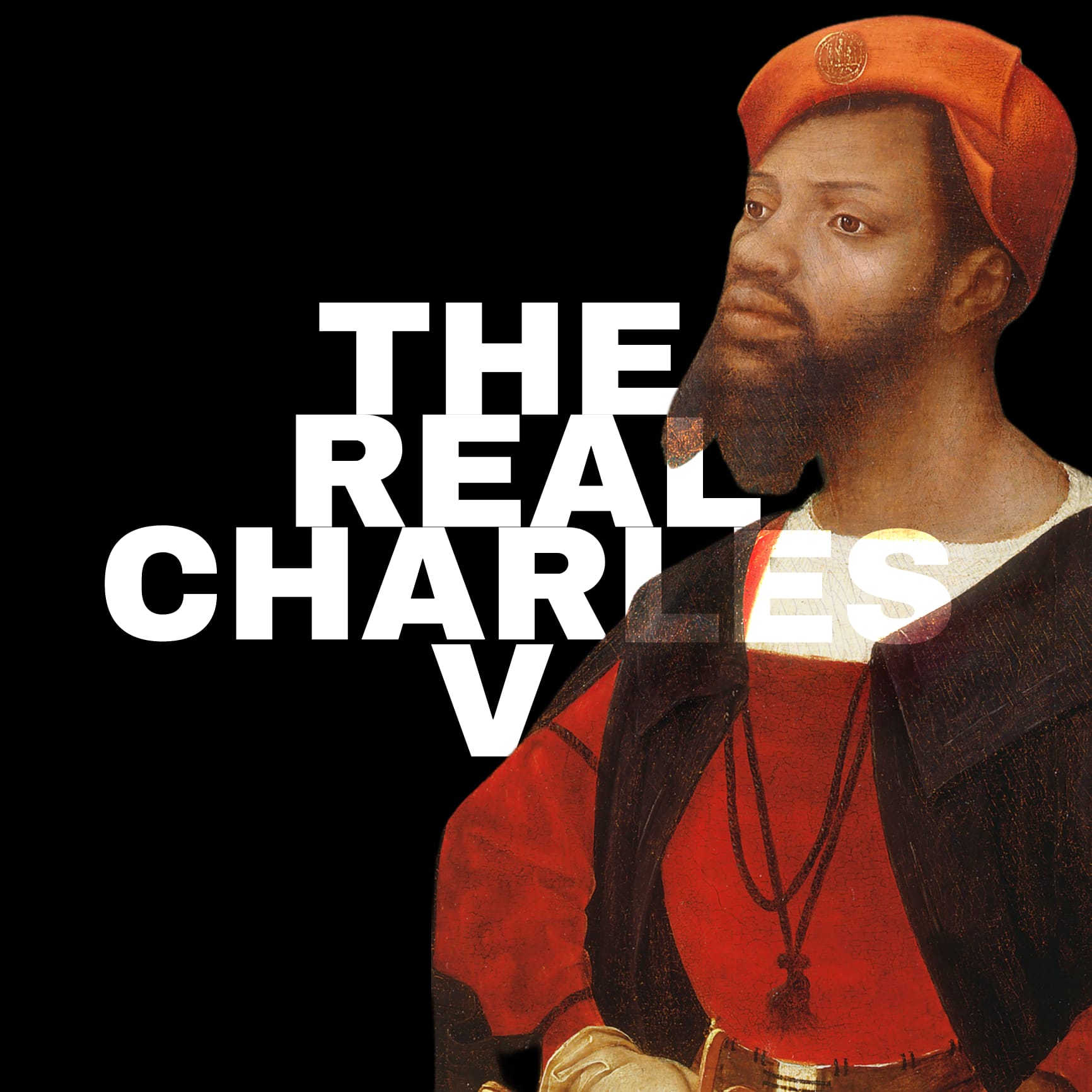
PAINTING I, PORTRAIT OF AN AFRICAN MAN (JAN MOSTAERT, c. 1520)

The first painting is today titled Portrait of an African Man. That title is modern. It does not originate with the painting itself.
The work dates to around 1520, the same year Charles V was crowned King of the Romans, and it is attributed to Jan Mostaert, a painter operating within the Habsburg court environment and closely associated with Margaret of Austria, Charles V’s aunt. Margaret of Austria served as regent of the Netherlands and maintained an active and highly selective court atelier. Jan Mostaert functioned within this orbit and was commissioned to paint figures of political importance rather than anonymous sitters.
This context matters. Court painters did not produce independent portraits casually. Such works required patronage, intent, and status. Margaret of Austria is documented as commissioning portraits of prominent figures within the imperial network, and Mostaert’s role was to visually stabilise authority through recognisable courtly codes.


Looking at the figure, nothing suggests servitude or marginality. He wears gloves, a conventional marker of aristocratic rank within European court culture. His posture is composed and controlled, consistent with elite etiquette rather than performative display. At his side is a sword fitted with a scent-stopper pommel, a type fashionable between approximately 1480 and 1530. Such swords functioned as markers of gentility and ceremonial entitlement, not battlefield equipment.


This was not the weapon of a soldier. It was an accessory of rank, worn by individuals authorised to bear arms in restricted courtly environments.
He also carries a richly embroidered bag decorated with the fleur-de-lis, a dynastic emblem tied to Burgundian and French royal inheritance. The fleur-de-lis was not a decorative flourish but a regulated symbol of lineage and sovereignty. On his hat appears an insignia associated with Our Lady of Halle, a pilgrimage destination south of Brussels frequented by members of the Habsburg family, including Charles V himself.


These details are specific. They are not generic. And they are European.
The usual explanation offered is that the sitter was an African archer or court curiosity, sometimes identified as “Christopher le More”. The problem is not controversy but absence of evidence. There are no primary or contemporary records confirming the presence of such an individual at court, nor any documentation that Jan Mostaert was commissioned to paint him.
For a figure portrayed with this degree of dignity, regalia, and symbolic coherence, that absence is telling.


When this portrait is compared with later, widely accepted portraits of Charles V, similarities emerge immediately: posture, dress conventions, accessories, insignia placement, and the broader visual grammar of authority. What changes is not identity but complexion.
PAINTING II, ADORATION OF THE MAGI (MASTER OF THE ANTWERP ADORATION)

The second painting is an Adoration of the Magi by the anonymous artist known as the Master of the Antwerp Adoration, active in Antwerp during the early sixteenth century.
Antwerp’s role is central rather than incidental. By this period, Antwerp had become the richest commercial city in Europe and the financial engine of Charles V’s empire. Spanish silver from the Americas flowed through its banking houses. German financiers such as the Fugger and Welser families operated extensively there. The city financed Charles V’s wars against France, the Ottoman Empire, and Protestant princes.
In 1515, Charles V was formally recognised in Antwerp as Lord of the Netherlands. This recognition preceded his accession as King of Spain in 1516 and Holy Roman Emperor in 1519. Antwerp’s political and financial backing was instrumental in consolidating his authority in the Low Countries.
Charles V frequently resided in Antwerp, held courts and ceremonies there, and used the city as a diplomatic hub. In practical terms, Charles V could not run his empire without Antwerp’s money.

In Renaissance art, the Adoration of the Magi was the preferred subject for elite patronage. The Magi were kings, and the scene allowed rulers to embed themselves within sacred history while publicly affirming humility before Christ. This was not symbolic indulgence but visual propaganda grounded in convention.
In his 1840 publication, a hand book for travellers in southern Germany, Murray States in regards to the Triptych of the adoration of the Magi, “The elder of the three kings is the portrait of Phillip the good, Duke of burgundy while the Moor is the likeness of Charles the bold… “


interestingly, but not surprising, a white washed version of this adoration piece exists where Prince Charles the bold has been replaced with a white version.


In this painting, a youthful melanated figure appears among the Magi. He approaches from the edge of the composition, hat removed, posture inclined. This gesture is often misread as exoticism. In reality, it is a standard European courtly sign of humility and deference, consistent across noble commissions of the subject.


He does not present the most overt regalia himself. This restraint is intentional.


In many Adoration scenes, the first or principal Magus and the second Magus may function as narrative proxies for the patron. Royal objects are placed in a Magi’s hands or at Christ’s feet, allowing the actual patron to remain visually humble while retaining symbolic association with sovereignty.
This division is iconographic shorthand rather than ambiguity. Authority is acknowledged without being theatrically asserted.

At the feet of the Christ child lie two critical objects: a royal sceptre and a royal ciborium. Their placement on the ground signifies the temporary submission of earthly authority to divine authority. Kingship is not denied. It is offered.
The ciborium is especially significant. As a Eucharistic vessel associated with the containment of the consecrated Host, it signals that sovereignty derives from sacramental legitimacy as much as political force. By offering a ciborium rather than a crown, the image fuses kingship with Catholic orthodoxy.
The Magus presents these objects within the narrative so that the king himself may approach without them, visibly humble, yet symbolically inseparable from them.
PAINTING III, THE CORONATION PAINTING (FALSELY TITLED ADORATION OF THE MAGI)

The third painting is commonly misidentified as another Adoration of the Magi. It is not. This is a coronation image structured through medieval and early modern political symbolism.
The sceptre held by the figure is slender, metallic, and topped with a stylised floral finial unmistakably resembling a fleur-de-lis. This is not a walking staff, baton, or allegorical rod. It is a sovereign sceptre consistent with Burgundian–Habsburg regalia traditions inherited through Burgundy.


Such sceptres are associated with dynastic authority rather than office. The fleur-de-lis finial reflects Burgundian–Valois ceremonial language absorbed into Habsburg symbolism following the Burgundian inheritance.


In the opposite hand, the figure holds a golden ciborium marked not with a cross but with a fleur-de-lis. This substitution is deliberate. Normally, coronation portraits favour the globus cruciger, signalling Christian dominion over the world. The ciborium instead introduces sacramental authority into the language of sovereignty.
By crowning the ciborium with a fleur-de-lis, the image fuses Eucharistic sanctity with Burgundian–French dynastic identity. Power is presented as inherited, sanctified, and legitimised simultaneously.
This symbolic departure reflects Charles V’s political circumstances. His prolonged conflict with France was rooted in genealogical claims to Burgundian and northern French territories. Following the capture of Francis I and the Treaty of Madrid, Charles V asserted moral and dynastic superiority even as legal claims remained contested.
The coronation at Bologna in 1530 linked imperial authority with papal legitimacy. Displaying the fleur-de-lis upon a sacred vessel visually claimed that Charles, rather than the French king, embodied the true Christian kingship of the Frankish line.


Behind the figure stands a walled city, and the city itself is not incidental decoration but a central component of the image’s political meaning.
The urban landscape is presented as a horizontally organised settlement set on a flat plain, with pronounced hills rising distinctly in the far distance rather than immediately behind the walls. The city is enclosed by continuous white defensive walls punctuated by towers and gates. Water is visible running alongside sections of these walls, functioning as a controlled moat or canal rather than as a broad natural river. The treatment of water is defensive and administrative, not commercial.
On the left-hand side of the composition stands a massive, fortress-like structure. It is blocky, austere, and militarised in appearance, with thick masonry and minimal fenestration. Crucially, this stronghold is itself surrounded by water, partially isolated from the surrounding urban fabric. This creates a striking visual hierarchy: a moated citadel imposed upon, or embedded within, a walled and moated city. Such layered hydraulic fortification signals internal domination and political control rather than simple external defence.
This configuration immediately excludes several commonly proposed locations. Antwerp, despite its dense skyline, was defined visually and economically by the River Scheldt. Contemporary depictions emphasise broad, active waterways filled with shipping, docks, and mercantile infrastructure. None of these appear here. The water in the painting is localised, contained, and defensive, and there is a complete absence of maritime or commercial activity. The left-hand stronghold does not resemble Antwerp’s Het Steen, which is consistently shown as an open riverbank fortress integrated into a bustling harbour environment.
Aachen can likewise be excluded. While symbolically important as a coronation site, Aachen lacked extensive continuous walls integrated with canal systems of the type depicted. It did not possess a large, moated internal citadel designed to dominate the city itself. Its skyline is also dominated by a single monumental cathedral complex, unlike the painting’s multiplicity of church towers and spires.


Bologna, by contrast, aligns on every critical point. Historically, Bologna occupied a flat plain with the Apennine foothills visible on the horizon, matching the painting’s topography precisely. The city was enclosed by substantial walls and was renowned for its sophisticated canal network, which served defensive, industrial, and administrative purposes rather than maritime trade.


Most decisively, Bologna possessed the Rocca di Galliera, a massive citadel imposed upon the city by ruling powers. Contemporary descriptions emphasise its moated isolation, hydraulic integration, and role as an instrument of internal control rather than civic protection. The fortress in the painting corresponds closely to this profile in scale, form, placement, and function. Its visual separation by water is not decorative but political.
The dense skyline of church towers further supports this identification. Bologna was known for its extraordinary number of ecclesiastical institutions, producing a clustered vertical rhythm without a single overpowering cathedral silhouette. This matches the painting exactly.
When read together, the flat terrain, distant hills, continuous white walls, controlled waterways, moated internal stronghold, and ecclesiastical density form a coherent urban signature that aligns most convincingly with Bologna.
This identification carries decisive political weight. Charles V’s imperial coronation took place in Bologna in 1530, uniquely linking imperial authority with papal legitimacy. When the Burgundian–Habsburg regalia held by the figure are read against a Bolognese cityscape, the image resolves into a unified statement of sovereign authority sanctified by the Church at the precise moment of imperial confirmation. In this context, the city is not a backdrop but a declarative setting anchoring the portrait historically and ideologically.

The tunic, easily mistaken for a golden armour displays floral engravings centred on a triangular petal motif with concentric ornamentation. Comparable designs appear in other portraits of Charles V.
GENERAL APPRAISAL , COMPARING THE THREE PAINTINGS


Taken individually, each painting invites debate. Taken together, they establish continuity.
Across all three works, the same individual appears at different stages of life: a court noble, a youthful Magus, and a crowned emperor. The visual language remains consistent. Burgundian–Habsburg symbols, courtly behaviour, and sovereign regalia.
Alternative explanations do not survive across all cases.
PAINTING IV, CAPAC CUNA INCA KING LIST


We will now consider the portrayal of Charles V in the Capac Cuna Inca king list. This painting illustrates the “genealogy of the Incas”. At the time, the Spanish monarchy sought, through various means, to legitimise it’s political power over the conquered territories. Consequently, it needed to demonstrate that the conquest of Peru did not signify the end of the Inca dynasty, but rather that the kings of Spain were their sole legitimate heirs.
This is why Charles V appears as the successor of Atahualpa, and Charles IV, the last king depicted, is shown as the 25th Inca emperor of Peru.
We can reasonably consider the Capac Cuna king list to be an accurate portrayal of the European monarchs represented in the painting because it was European Commissioned particularly by the Spanish monarchy. Where mainstream historical narrative standards would have us expect to see a pale-skinned king and emperor, we are instead presented with the image of a fully melanated man.
Some have suggested that this was merely propaganda intended to depict these European rulers as descendants or realistic continuations of earlier Inca emperors. The idea that European monarchs would deliberately darken their own appearance in portraiture to appeal to a conquered foreign population is, to say the least, curious.


Nevertheless, it stands as solid evidence against the whitewashing of history. To further illustrate this point, one need only compare it with a whitewashed version of the same historical painting. Not only have the Europeans been lightened considerably compared to the original document, but the image of Jesus as a Black man has been entirely erased and replaced.

This demonstrates, quite plainly, the lack of historical fidelity displayed by modern white European narratives. It is not an exaggeration to question the true racial depiction of most, if not every, historical figure retold by modern Europeans, given these consistent whitewashing tendencies.


A similar case of white washing can be demonstrated by observing two versions of the same painting titled The Delivery of the Augsburg Confession, 25th June 1530. This specific version of the painting is dated to around 1617. Subtle and overt colour alterations can be seen among various versions of the painting online. The most extreme can be seen below:

The Augsburg Confession, delivered on 25 June 1530, was a pivotal event in the Protestant Reformation. Prepared by the reformer Philip Melanchthon, this formal statement of Lutheran faith was presented to Holy Roman Emperor Charles V during the Imperial Diet at Augsburg. While its stated purpose was to seek reconciliation with the Catholic Church, the political context was crucial: Charles V urgently needed the military support of the German Protestant princes to confront the advancing Ottoman Turks. The respectful delivery of the document represented a bold yet diplomatic attempt to bridge the growing religious divide within the empire.
Ultimately, the attempt at reconciliation failed, as the Catholic side rejected the Protestant arguments. Nevertheless, the event was a landmark moment. It clearly and officially defined Lutheran doctrine for the first time, cementing the permanent split in Western Christianity. The painting itself, created nearly a century later in 1617, commemorates this foundational act. By depicting the dramatic delivery, the artist celebrated the courage of the Lutheran founders, ensuring the memory of this defining confrontation remained alive for future generations.
The Augsburg confession painting validates the blackness of Charles V. Unlike his unidentified paintings, the Augsburg confession is agreed to portray Charles V. This painting alone throws a wrench into the historiography of white European history. By itself, it single handedly exposes the chronic white washing of Europe’s history. It contradicts every single white appearance of the monarch and demands a logical explanation for such crass racial discrepancy. Combined with his other contested portraits which show him in his true likeness, the story of Europe’s melanated past becomes undeniable. The Augsburg confession consolidates the true black appearance of Charles V and renders the fallacy of a solely white European history ruled by a class of solely white monarchs not just a bold faced lie, but a premeditated racial appropriation of Europe’s legacy.

The Fallacy of the “Habsburg Jaw” and Royal inbreeding


The so-called “Habsburg jaw” has long been presented as anatomical proof of dynastic degeneration, routinely attributed to mandibular prognathism caused by centuries of close-kin marriage. This explanation has been repeated so consistently that it has achieved the status of fact. Yet when Charles V’s portrait corpus is examined anatomically rather than rhetorically, the explanation collapses. The dominant subset of his accepted white portraits does not exhibit true mandibular prognathism at all. Instead, they consistently display subnasal prognathism, forward projection of the maxillary region beneath the nose, a trait common among people of African descent and structurally distinct from mandibular jaw protrusion.


Mandibular prognathism involves forward projection of the lower jaw, producing a prominent chin, altered mandibular angle, and clear skeletal imbalance. Subnasal prognathism, by contrast, involves maxillary projection without disproportionate advancement of the mandible. The distinction is not semantic, it is anatomical. In Charles V’s white portraits, the chin is often modest, the mandibular angle remains within European norms, and the facial projection is concentrated beneath the nasal aperture. These features do not align with clinical or comparative examples of mandibular prognathism. They align precisely with a maxillary-forward facial structure.


This distinction becomes decisive when the process of whitewashing is examined directly. When an authenticated European painting of Charles V, preserving facial contours, proportions, and outline, is whitewashed without alteration to underlying geometry, the resulting image mirrors the dominant subset of Charles V’s accepted white portraits. This is not resemblance by coincidence, it is structural equivalence. The persistence of “prognathism” across the whitewashed image is not evidence of deformity but evidence of origin. A Black facial structure was retained while pigmentation was altered, producing a face that European observers could not anatomically contextualise within their own population.
Faced with a facial architecture that did not naturally occur among Europeans, historiography reached for a rationalising explanation. Inbreeding provided the perfect cover. It was logical, difficult to dismiss, and conveniently pathologised the anomaly. Royal intermarriage was real, and deformity among heirs was plausible. The narrative required no confrontation with the possibility of Black nobility at the highest level of European power. Thus, subnasal prognathism was mislabelled as mandibular deformity, and a structural trait became a medicalised flaw.

Portraiture inconsistency further exposes the fallacy. While a small number of Charles V portraits do depict exaggerated mandibular prognathism, these images function as outliers rather than representatives of the dominant tradition. The largest, most internally consistent group preserves maxillary projection with restrained mandibular form, indicating that these works were derived, directly or indirectly, from a common underlying facial template. The truly mandibular prognathist images are better understood as products of extreme artistic licence, deployed to convert difference into grotesquery. Such exaggeration is a familiar tactic in smear campaigns against Black nobility, transforming ancestry into abnormality.


This strategy is not unique to Charles V. Identical propaganda mechanisms were employed in the de-Africanisation of ancient Egypt. Subnasal prognathism in royal mummies was reinterpreted as “buck teeth”, supposedly caused by inbreeding. African hair textures and hairstyles were dismissed wholesale as wigs, as though it were plausible for an entire civilisation of non-Black people to consistently adopt and preserve another race’s hair morphology through artificial means. These explanations were not neutral errors, they were defensive inventions designed to preserve a Eurocentric narrative when physical evidence contradicted it.


The repetition of these tactics across time and geography reveals a system, not an accident. When African anatomical traits appear in elite contexts that Eurocentric historiography cannot accommodate, pathology is invoked. Deformity replaces ancestry. Inbreeding replaces origin. Artistic exaggeration replaces honest representation. The “Habsburg jaw” is therefore not a settled biological diagnosis but a historiographical construct, a solution devised to explain away the persistence of African craniofacial structure after the whitewashing of a Black king.


Whitewashing the true portraits of Charles V produces faces that align seamlessly with the majority of his accepted white portraits because those white portraits are derived from a Black original. The consistency is too high, the anatomical alignment too precise, and the alternative explanations too strained to be dismissed as coincidence. The remaining portraits that display overt mandibular prognathism are not corrective truths but distortions, visual propaganda layered onto an already erased reality.
In a historical record built on truth, such contradictions would not persist. That they do, and that they follow the same pattern used elsewhere to separate Black people from their past, exposes the “Habsburg jaw” not as evidence of degeneration, but as evidence of systematic historical erasure.
CONCLUSION
Across Europe and the Americas, by different artists and in different political contexts, the same figure appears consistently associated with imperial authority. What changed was complexion.
Random Africans do not commission court portraits, appear as Magi kings, stand crowned before Bologna, or bear Burgundian regalia. Charles V does.
Understanding this requires abandoning modern racial projections in favour of historical political realities shaped by dynasty, religion, and power rather than modern racial ideology.
post-publication updates:
Parade Helmet of Charles V


This is the Burgonet helmet of Emperor Charles V, a magnificent piece of armor created around 1533. The style of the armor mimics features of the King/Emperor it was crafted for. The hair texture, beard style, and texture, including the forked goatee, all precisely align with observable features of the emperor in his black portraits. It was crafted by the renowned Milanese armorer Filippo Negroli. The helmet is made of embossed and gilt steel, designed to look like the Emperor’s own head and profile with tight curly hair and beard. It served as a ceremonial parade helmet rather than functional combat gear, symbolizing prestige and authority.


Leave a Reply to sableindianCancel reply