
Introduction

The scholarly discourse surrounding ancient Egyptian skin tone representation requires careful examination of artistic techniques, material preservation, and historical context. The surviving artefacts tell a complex story of pigment application, natural degradation, and modern interpretive biases that collectively reveal how the ancient Egyptians portrayed themselves.
Pigment Use and Artistic Techniques Across Kingdoms
The evolution of Egyptian painting methods reveals significant differences between Old and New Kingdom practices. During the Old Kingdom (2686-2181 BCE), artisans typically applied pigments directly to stone surfaces without preparatory layers, using thinner, more translucent paint applications that integrated with the natural stone tones. This technique explains why many Old Kingdom works now appear nearly colourless, with only faint pigment traces remaining in protected crevices.

The New Kingdom (1550-1070 BCE) witnessed technical advancements in artistic practice. Artists systematically applied reddish undertones before final colouring, used thicker opaque pigment mixtures, and incorporated protective varnishes. These methodological developments account for why New Kingdom works often maintain visible colouration despite centuries of exposure, while their Old Kingdom counterparts have lost most pigmentation.


Material Preservation: Wood vs. Stone Artefacts


The superior preservation of pigments on wooden statues provides crucial evidence for original skin tone depictions. Wood’s absorbent nature allowed for deeper pigment penetration and retention compared to stone surfaces. Middle Kingdom wooden statues like those of Senusret I display remarkably intact dark brown complexions that almost certainly reflect their original appearance.
In contrast, stone stelae and reliefs frequently exhibit only residual reddish tones where the original darker layers have completely faded (many cases are caused by modern tampering). This material difference has led to widespread misinterpretation, with some scholars mistaking these degraded surfaces for intentional artistic choices rather than understanding them as artefacts of preservation.
Gender Representation and Divine Iconography
The purported systematic depiction of men as reddish-brown and women as yellow requires nuanced examination. While some artworks do show this pattern, it could be best argued to show natural human variation within African populations rather than rigid artistic convention or the Eurocentric idea of men tanning brown and women not tanning. Many African ethnic groups demonstrate subtle undertone differences between genders, with women often exhibiting slightly yellower hues compared to men’s reddish tones.


The use of golden-yellow pigments for divine figures presents a separate consideration. Deities like Hathor received bright yellow coloration representing their golden, divine nature rather than literal skin tone. Non-royal tomb paintings show women in various brown shades, demonstrating that the “yellow women” theory applies primarily to religious iconography rather than everyday portraiture.
The Hierarchical Use of Yellow and Gold in Ancient Egyptian Sarcophagi
Archaeological evidence suggests that non-royal sarcophagi often featured bright yellow paint as a symbolic approximation of gold—a deliberate aesthetic choice rather than a naturalistic representation of skin tone (Taylor, 2001). This practice reinforced a visual hierarchy, wherein yellow pigment served as a “commoner’s gilt,” gilding as a “noble’s gold,” and solid gold as an exclusively royal prerogative. Unfortunately, due to millennia of tomb looting, most surviving examples are now stripped of their original gilding, leaving behind yellow-painted surfaces that are frequently misinterpreted in modern displays as naturalistic coloration (D’Auria et al., 1988).

Case Studies in Pigment Preservation and Modern Intervention
The seated scribe (Louvre, E3023) exemplifies both original preservation and modern distortion. Protected areas like knees, hands and feet retain their original dark brown colouration, while the torso suffered aggressive 19th-century cleaning that removed surface layers. Subsequent restoration created artificial contrast between cleaned and untouched sections, fundamentally altering the statue’s appearance.


The Nebamun tomb paintings (British Museum, EA37977-37984) present another revealing case. Vibrant hunting and festival scenes, and a moderately well-preserved representation of the Noble and his family. Nebamun’s statue retains a darker hue of brown than his frescoes in his tomb.


The Rahotep and Nofret statues (Egyptian Museum, CG3-4) display suspiciously uniform orange-red tones and clearly painted hieroglyphic inscriptions. This makes the throne of Rahotep, the only instance of hieroglyphs painted on stone rather than the symbols carved into it. The black paint of the hieroglyphs shows no sign of degradation despite the hair of Rahotep showing signs of colour degradation and weathering. This points to a recent repaint or total fabrication of the hieroglyphs. Further analysis of the hieroglyphs can put to bed, these suspicions.


The canopic jars of the boy king, Tutankhamun, show odd coloration unlike other canopic jars in ancient Egypt. His lips have been painted pink, and his eyeliners and eyebrows have been restored with black pigment to give a sharp contrast in appearance. This gives a false impression that the colour of the stone infers real-life complexion.


The wooden statue referred to as Ka-aper, found in the Cairo museum in Egypt retains very little colour or varnish. The statue is of an Egyptian priest and scribe from the old kingdom era. His wooden statue has been made famous due to its highly intact state. Despite its lack of colour today, the statue can be observed to have black eye liners around the eyes. A sure sign of restoration on the part of those who currently house the statue. But it is curious that such a specific detail is restored and nothing else.


Pigment Chemistry and Degradation Patterns
The chemical behaviour of ancient pigments explains many current appearance issues. Iron oxide ochres (red/yellow) remain chemically stable over time, becoming more visible as other pigments fade. Carbon-based black outlines, being organic compounds, degrade fastest and are frequently the first elements to disappear from artworks. Modern conservators often repaint these losses, creating false contrasts.
Copper-based blue and green pigments undergo chemical transformations, often darkening or turning black over time. Their degradation significantly affects overall colour balance in surviving artworks, making original compositions difficult to discern without scientific analysis.
False color representation in media


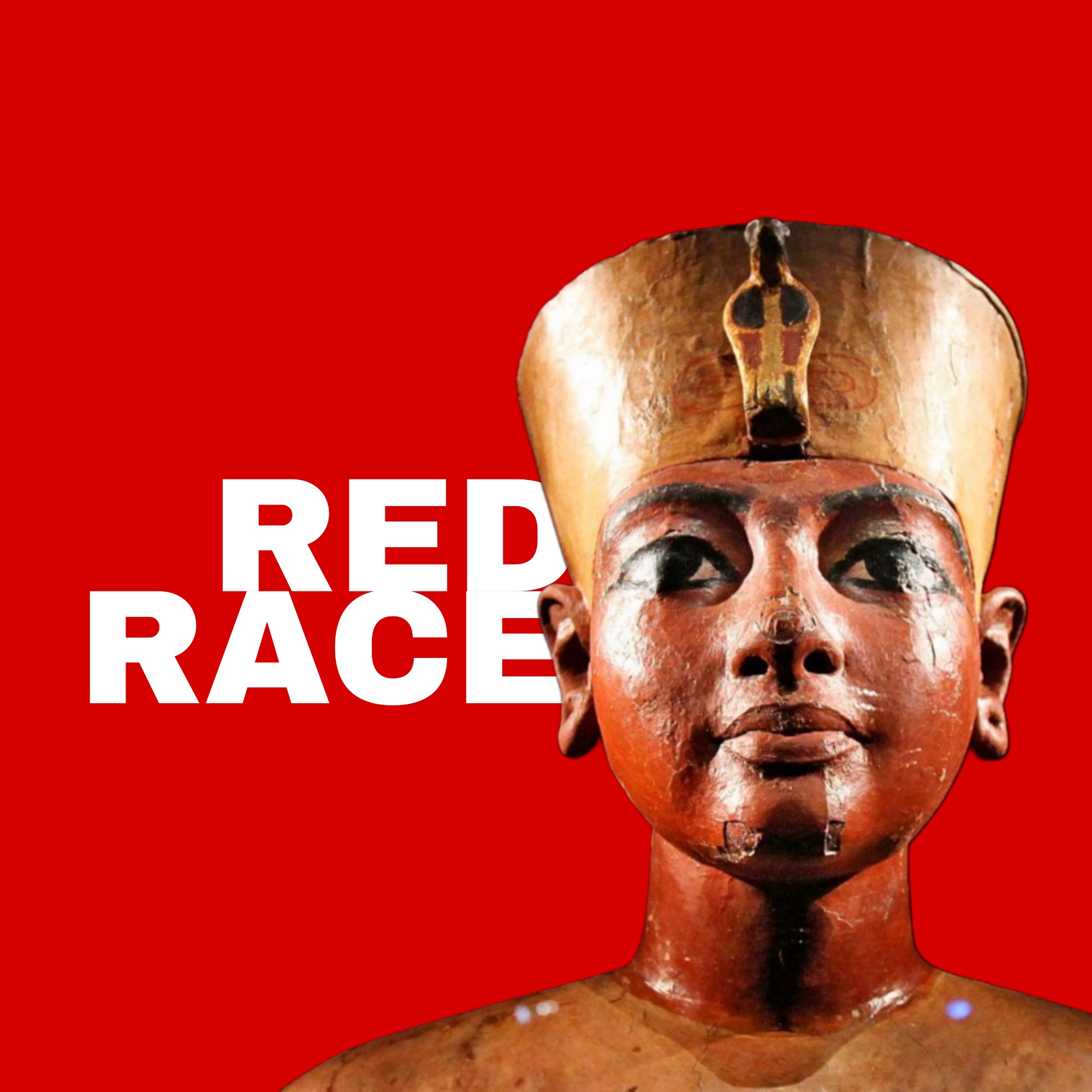
Unfortunately, the majority of ancient Egyptian monuments and arts are intentionally edited digitally to give off a false reddish tone. To unsuspecting individuals, these representations online could be taken as factual.


In rear instances where unedited media is made of these artefacts, a less red and rather brown reality sets in.


Group representation of ancient Egyptians in arts
Ancient Egyptian artistic convention utilises a broad range of colours for realistic and symbolic representation of individuals and groups of people. By studying preserved artworks spanning thousands of years, repetitive patterns of colour representations have been observed that can be considered as cultural artistic convention by Kemetic artists. Colour representations in Kemetic convention are not rigidly imposed but rather, depend on delicate nuances that can only be interpreted by understanding the cultural psychology of the people who made these arts thousands of years ago. Unfortunately, African cultures that share similar cultures have been ignored and Egyptologists have over depended on their own divergent cultural worldview to understand this alien culture that wouldn’t be so strange if it were to be viewed through the African lens that it was known to be from. In light of this inadequacy of cultural perspective, African scholars have taken the initiative to understand, corroborate, uncover and debunk colour understanding within the Kemetic cultural sphere.
On frescoes, it is observable that groups of people are represented with alternating tones of skin colour. This not only represents the diversity of complexion within the Kemetic society being portrayed, it also aids visual appreciation of individuals within a group.


Due to the use of colour symbology in Kemetic art convention, it is important to isolate artistic representations that show realistically the appearance of the inhabitants of ancient Egypt in realism and as they saw themselves. Wooden figurines found in various tombs display day-to-day activities in ancient Egypt and show the peopling of Kemet in a lifelike manner that leaves no room for speculation. From armies to mercenary soldiers, to burial ceremonies and domestic work, various aspects of life are captured in action and colour.


The representation is clear and absolute on how the ancient Egyptians saw themselves and the complexion they chose to realistically portray themselves in. One doesn’t need to look far away from modern Egypt or the African continent to find populations such as these.
Nubian representation with reddish brown
Nubian and ancient Egyptian history is intertwined together for as long as Kemet has existed. Many scholars agree that Kemet was an offspring civilisation of Nubia and some have gone further to refer to the entire region encompassing both Kemet and Nubia in all matters of material and immaterial culture as the nubio-kemetic complex. Despite the fact that both civilisations are actually near identical in almost every regard, some, especially those of Eurocentric extraction, prefer to treat these two regions as distinct despite evidence to the contrary.
There is no room to doubt that the Nubians were of black or melanated African stock as was their culture. All of academia agree to this. And as history would have it, Nubian representation in Kemetic artworks both as rulers of Kemet and as foreigners are abundantly available. These portraits show Nubians as phenotypically indistinguishable from ancient Egyptians in most cases, leaving only a hint of culture to tell them apart. In the case of the Nubian Pharaohs, they are virtually identical to other Pharaohs who can be considered as non-Nubians. So what do we make of the instances of Kings and foreigners we all know to be black or melanated Africans being represented in reddish-brown complexion like their ancient Egyptian counterparts? Do we also entertain the possibility that these Nubians were of red-skinned complexion like many view the ancient Egyptians? Or do we accept the artistic reality for what they are?


Cultural Continuity and African Representation

The physical features in Egyptian art maintain striking continuity with modern African populations. Hairstyles including tight coils, braids and the distinctive “kemetic short twist” find direct parallels in contemporary East African traditions. Roman-era depictions of upper Egyptians, such as the Dendera acrobat, confirm these were authentic cultural practices rather than artistic conventions.
Facial characteristics including broad nasal structure, full labial morphology and pronounced zygomatic arches align with Nubian and Nilotic populations. The argument that these features represent “wigs” or stylised representations lacks evidential support from comparative anthropology.
Reconstructing an African Egypt
The cumulative evidence from artistic techniques, material science and cultural comparison confirms that ancient Egyptians portrayed themselves as they physically appeared – as dark-skinned Africans. The apparent “red” appearance of many artefacts results from differential pigment preservation favouring iron oxide survival, compounded by modern restoration practices that exaggerate lighter tones. Only through rigorous, bias-free examination of the material record can we properly understand ancient Egypt as an African civilisation in both cultural achievement and physical anthropology. The artefacts themselves provide unambiguous testimony when studied with proper attention to their material history and technical composition.
This article is adapted from research conducted by Andrew A. King (The Kings Monologue).


Leave a Reply