
Introduction
The video response under consideration addresses renewed claims made by the Eurocentric YouTube content creator known as Metatron regarding the Tomb of Seti I and the pigmentation of ancient Egyptians. These claims stem from a misinterpretation of an academic paper produced by the University of Florence, which focused on a specific fragment of Seti I’s tomb. This analysis provides a methodical breakdown of Metatron’s assertions and draws upon a wide range of counter-evidence found in original tombs, statues, and the broader African historical context. The paper challenges Eurocentric methodologies that cherry-pick and misrepresent data, using Metatron’s latest presentation as a case study in selective scholarship.
The Revival of a Discredited Narrative
Despite previous rebuttals, Metatron revisited the topic of Black Egypt, using a paper that was poorly understood or deliberately misrepresented. The expectation was that such arguments had been exhausted. Observers were surprised to see the return of old narratives, given the growing body of evidence and past discussions. Metatron had previously demonstrated moments of self-evaluation, which encouraged some to believe there had been intellectual growth. However, the return to labelling critics as ‘Afrocentrics’ while promoting Eurocentric arguments indicated a reversion to entrenched positions.
Reliance on a Faulty Reproduction

Metatron’s foundational argument centres on his admiration for Minutoli’s reproduction of the Tomb of Seti I—a work not only considered aesthetically inferior but also factually inaccurate. This reproduction is not a true facsimile, yet it is repeatedly used as a primary source for conclusions about ancient Egyptian pigmentation. The issue is not simply the low quality of the reproduction, but the insistence on relying upon it when many other untouched and original tombs are available for analysis. This pattern is consistent with broader Eurocentric tendencies, where isolated fragments are used to make sweeping claims, while accusing others of cherry-picking. The irony lies in presenting a manipulated or limited source as representative while dismissing broader datasets offered by others.
On the Inconsistency of Evidence Standards

An illustrative example is the case of Queen Tiye. A detractor presented an image of her from tomb TT227—a 19th Dynasty tomb constructed 200 years after her death—in which she is shown in her deified form as Hathor with yellow skin. This yellow skin, standard for Hathoric depictions, represents gilding, not racial phenotype. The claim that this singular image overrides the dozen-plus busts of Queen Tiye from her lifetime—each unmistakably portraying her with African features—is demonstrative of the Eurocentric approach. In contrast, those advocating for a Black Egypt invite the full scope of evidence to be evaluated, not singular artefacts taken out of context.


Clarifying the Florence Paper’s Scope and Conclusions
The paper in question, titled ‘The Tomb of Seti I in the Florence Egyptian Museum: Integrated Non-Invasive Methods for Documentation, Material History and Diagnostics,’ does not study the entirety of KV17. Instead, it focuses narrowly on one extracted fragment—specifically, a jamb removed and transported to the Louvre—with analysis centred on its material degradation and treatment history. The fragment studied was subject to non-invasive methods, meaning no physical samples were extracted. This severely limits any direct pigment analysis and negates claims of absolute conclusions about original coloration.
Metatron’s video suggests that the paper proves pigments darken over time and that this darkening misleads viewers into thinking ancient Egyptians were darker than they actually were. However, the actual conclusions of the paper contradict this. The authors clearly state that the fragment underwent ‘several repaintings, retouches, and protective treatments.’ It is also revealed that the fragment was found in pieces, then reconstructed using plaster and gypsum—requiring further paint integration to mask the reconstructions. This entire history introduces substantial colour distortion that cannot be attributed to natural pigment ageing alone.
Visual Deconstruction of the Pigment Argument


Metatron uses a comparison of two images—one of the current Florence fragment and a coloured drawing attributed to Champollion—to argue that pigments darkened over time. In his analysis, the hair of the goddess Hathor is said to have changed from blue to black, implying darkening. A closer inspection, however, shows that the hair remains blue in both images, merely appearing darker in shade. This is verifiable even within the very images Metatron presents.
More importantly, other colours within the same fragment show contradictory behaviour. Hathor’s dress, originally shown in a brownish tone, is now almost white. Seti’s white gown and the hieroglyphs themselves appear brighter in the present-day fragment than in the drawing. This reveals that there is no universal darkening taking place. Some areas have darkened, others have lightened, and some colours have disappeared altogether. The argument that pigment darkening equates to the original figures having lighter skin collapses under scrutiny.
On the Nature of the Source Image

The drawing Metatron refers to as evidence of original coloration is not a facsimile or direct rendering. It is a hand-coloured illustration published in a 19th-century book under the direction of Champollion and Rosellini. The drawing includes shading under the eyes and chins—features never found in original Egyptian artwork, which used flat, solid colour fields. This confirms that the illustration is interpretative rather than documentary. No analysis is provided in the Florence paper to assert the colour accuracy of this drawing.
Pigment Behaviour and the Paper’s True Conclusions

Within the paper, extensive imaging was employed, including VIL (visible-induced luminescence) to detect where Egyptian blue had once been applied. In one figure, a belt from Seti’s figure shows that only remnants of the blue pigment survive. Where blue zigzag patterns were once vibrant, only faint traces remain. This constitutes clear evidence of pigment fading, not darkening.
The Florence study concludes that pigment changes are inconsistent and context-specific. The fragment shows a mix of muddied, faded, or completely missing colours, all attributable to its complex treatment history. The authors make no claim about universal pigment darkening. The only definitive conclusion they reach is that the artefact’s current appearance is not original.
Alternate Fragments and Ignored Evidence

Another fragment from the same tomb, housed in a different museum, preserves a far richer and darker pigment tone. This piece was not subjected to the same restoration interventions as the Florence fragment. Visual inspection confirms the dark brown hue of the depicted skin—further disproving claims that original figures were pale and have since darkened.
Rather than using such alternate pieces for comparison, Metatron ignores them. This omission of adjacent evidence further illustrates selective presentation and intentional bias. The broader body of tomb evidence, when taken into account, tells a consistent story of Egyptians being depicted in various rich tones that correlate with African phenotypes.
False Ethnic Categorisation of Tomb Figures
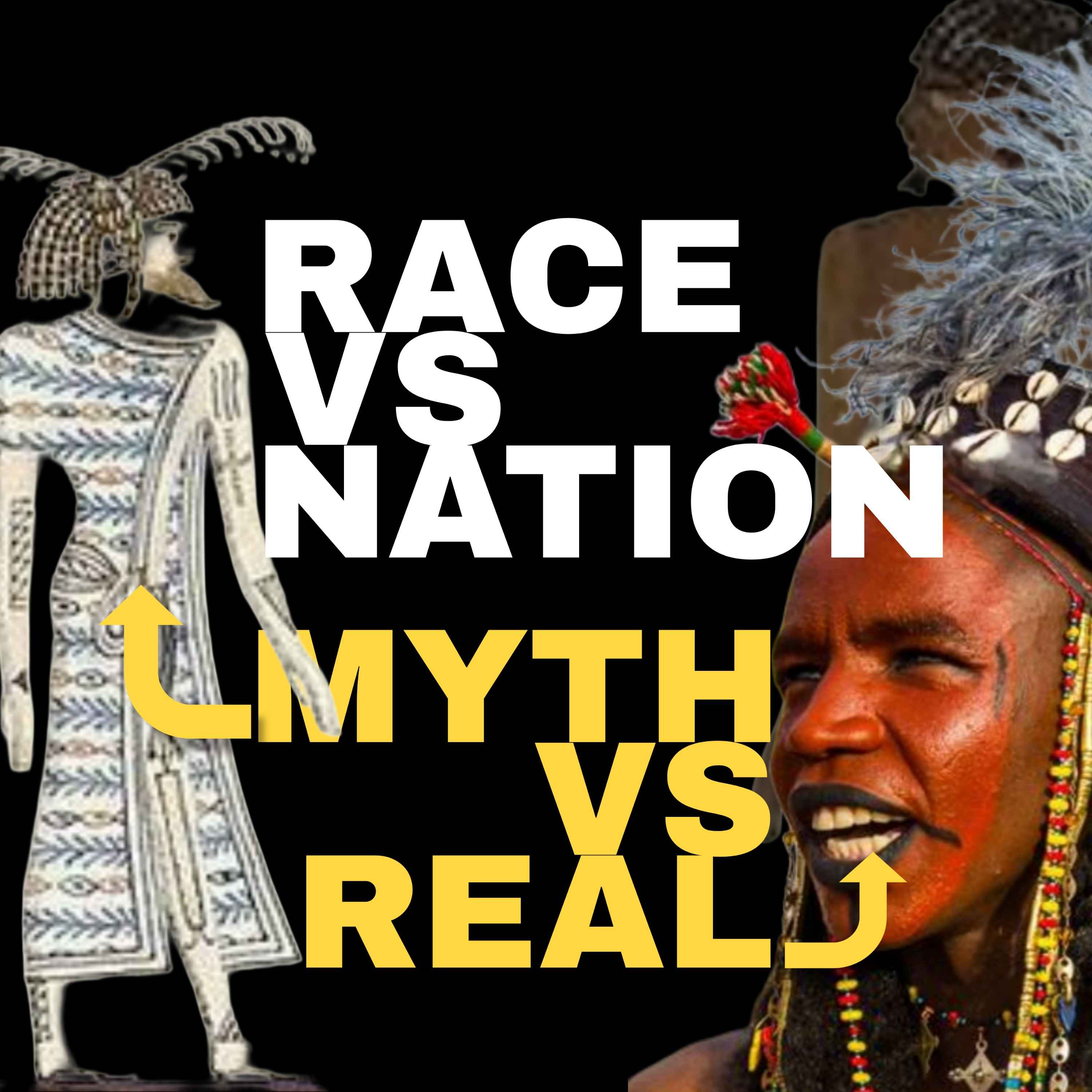
Metatron asserts that the tomb of Seti I depicts Black Nubians alongside lighter-skinned Libyans and Asiatics, identifying Libyans by the ostrich feathers in their hair. He then claims that Libyans were white. This categorisation is refuted by both historical and environmental logic. Ancient Libya recorded the hottest temperature on Earth—58°C—making the survival of pale-skinned populations in that region highly unlikely without modern protective technologies. The consistent depiction of Libyans with distinct feathered hairstyles and African features further negates any white European association.
Modern depictions by Metatron and Minutoli show Libyans as pale-skinned, which is inconsistent with environmental and artistic realities. Real Libyan figures in tombs display phenotypic traits more closely associated with groups such as the Fulani, with similar hairstyles and darker complexions. A separate article goes in depth into this specific subject. Click here to learn more.
Damage from Restoration Practices
Further deterioration of original pigmentation resulted from 19th-century practices, particularly the use of wet paper casts to create impressions of wall art for European collectors. This practice stripped pigment and left many artworks degraded or stained. While Metatron briefly acknowledges this, he frames the damage as incidental rather than a cause of lightening or fading, thus avoiding the implication that present-day lighter hues are the result of pigment loss. Yet visual and textual evidence shows widespread pigment disappearance, especially of colours like Egyptian blue.
Where pigment has remained, muddiness in skin tone may be observed. Even so, the pigmentation that survives—dark brown, in most cases—continues to contradict the pale tones found in Eurocentric reproductions. Claims that ancient Egyptians varnished their artwork to create false darkness are unsupported by the Florence paper, which documents colour changes as the result of modern handling, not ancient technique.
Phantom Representations and the Roman Claim
Metatron introduces the claim that some tombs depict Romans with European features, citing brown hair and fair skin as evidence. However, tombs from the dynastic period predate Roman presence in Egypt. No known dynastic tomb includes figures labelled or identified as Romans. While late-period artworks may reflect Greco-Roman influence during foreign rule, these are not part of the period under discussion. The claim introduces confusion and lacks archaeological support.
The Africanity of Ancient Egyptian Phenotypes

The claim that ancient Egypt was multiethnic is not necessarily false, but it is often misused. The variation seen in Egyptian art—ranging from wide-nosed to aquiline-nosed individuals, various hair textures and skin tones—is fully represented within indigenous African populations. From the Nile Valley to the Great Lakes, African phenotypes display the full spectrum of traits depicted in Egyptian iconography. There is no need to import non-African groups to explain artistic diversity.
The claim that all light skin must imply non-African origin is itself based on colonial thinking. The reddish-brown used to depict men in Egyptian art is common in modern African populations. So is the yellow-brown or caramel hue used for women. The Egyptians had no need to invent people; they painted what they saw. And what they saw was Africa.
Conclusion
The claims made by Metatron regarding pigment darkening, the interpretation of the Florence study, and the ethnic composition of ancient Egyptians are shown to be incorrect, misleading, or selectively presented. The study used as the cornerstone of his argument explicitly states that the examined fragment was subject to repainting, retouching, and protective treatment. Pigment degradation is shown to be inconsistent—some colours darken, others fade, and many disappear. Evidence from alternative fragments and untouched tombs supports the depiction of Egyptians as richly pigmented African people.
Metatron’s interpretation relies on manipulated imagery, faulty comparisons, and a misreading of the Florence paper’s intent. Ancient Egypt was an African civilisation, and its people, art, and culture reflect the depth and diversity of that heritage. The attempt to Europeanise its visual legacy through cherry-picked images and degraded fragments cannot stand against the full scope of archaeological, artistic, and environmental evidence.


Leave a Reply