
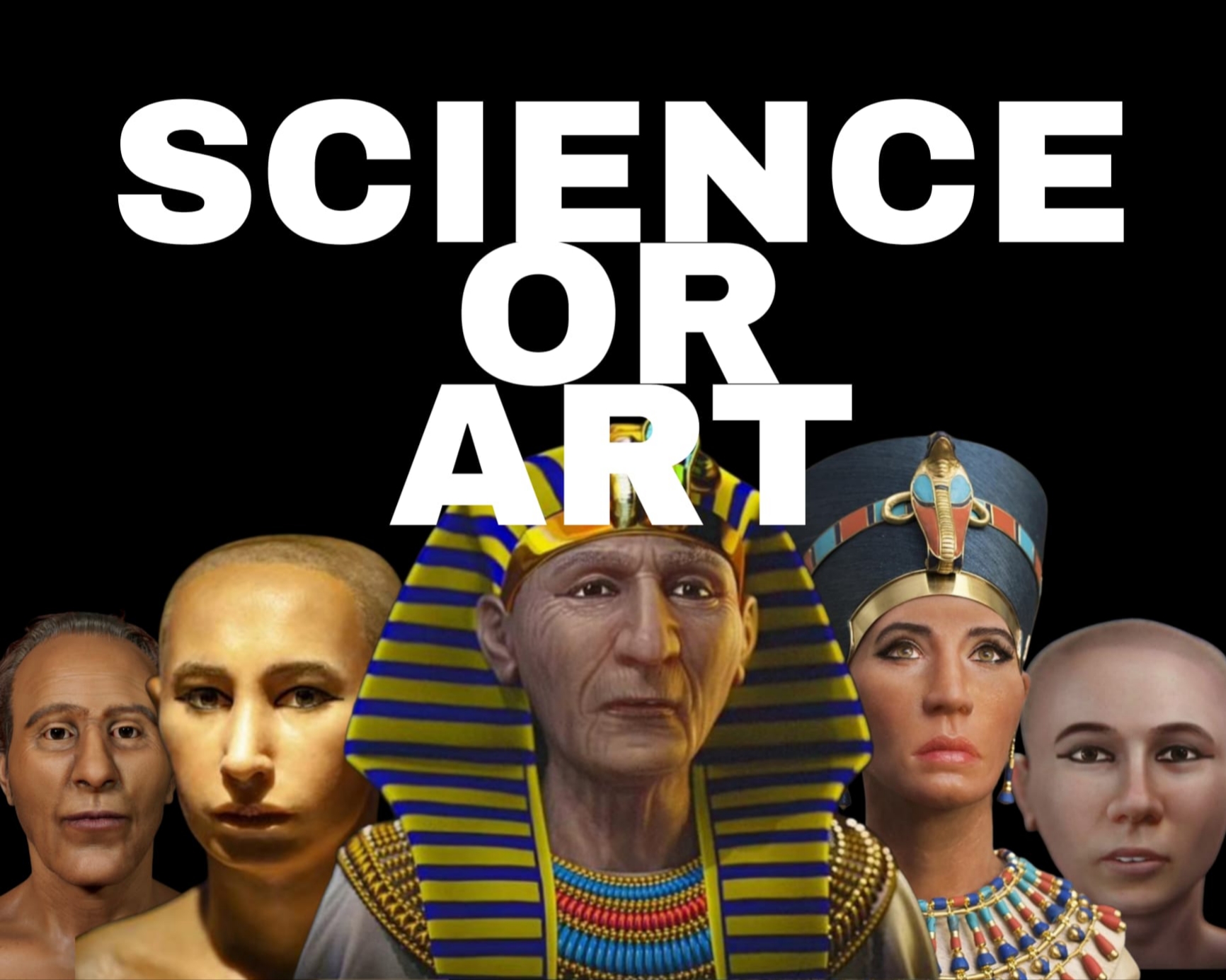
Previous Reconstructions of Ancient Egyptian Figures
The portrayal of ancient Egyptian figures through forensic facial reconstruction remains controversial, but has been ceaselessly pursued by historians, anthropologists and other interested parties (Wilkinson 2010). Sanctioned reconstructions have often been criticized for their lack of objectivity, with questions surrounding eurocentrism and racial bias. This can be coupled with the known tendency to project present values of race and national identity onto an ancient people whose perspectives were not binary so our own in present day (Crawford 2021), and had no knowledge of race as a social construct. The tendency to illustrate Ancient Egyptians as a Eurasian leaning population has its root in centuries of anti-African sentiment and outdated racial distinctions that have been present since inception of Egyptology (Keita 1997), forcing early Egyptologists to decide where in the rigid racial schema (Mongoloid vs. Caucasoid vs Negroid) this ancient society belonged. These same notions of race can be seen today in the field of reconstruction, where, in spite of substantial anthropological data suggesting otherwise, Eurasian phenotypes continue to be applied, as default, by the various teams carrying out approximations. These decisions regarding race and phenotype are not being driven by anthropology.
¹ In recent years, the ‘Egyptian Antiquity’ has become increasingly harsh towards any exploits by archaeological teams and anthropologists linking the Ancient Egyptian civilization to the wider African population. This has been demonstrated by bans against archaeological teams and even lawsuits against Media outlets. – All focused against Ancient Egyptians being ‘black’.
Double standards in the treatment of Egyptian portraiture
Ironically, Amenhotep III, prior to this recent attempt by the multinational team, is seldom approached as a subject for forensic facial reconstruction attempts. It is possible that in spite of him being a significant New Kingdom monarch, his portraiture is so overtly African that apart from a handful attempts, he is, for the most part, considered to possess an overtly African phenotype. Or, among the fraternity of non-commissioned reconstruction artists (like myself) there is at least the consensus that he is presented most commonly as a continental African man, even by Eurocentric artists.
Brunton’s Depiction of Amenhotep III
Ironically, there is a famous attempt to depict him by 19th Century Artist and Egyptologist, South African Winifred Brunton, who was renowned for her ‘talent’ of transforming Egyptian monarchs into vaguely hellenic dressing, aryan looking, indo-Europeans. She is largely regarded as ‘the 1st person to consider the living appearance of the kings and queens of Egypt through portraiture in the 1920s.’ (Wilkinson 2023)

She, in consistent form, depicted Amenhotep III as a clinically obese, very white, caucasian male. Ironically, in many ways, it was nearly identical to the one approximated by Moraes and team. However, she did so without the aid of ‘forensic’ processes, or any comparison to the skull. Ms Brunton’s artworks have openly been described as ‘enhanced illustrations of the existing statues’ and in spite of being a keen egyptologist who studied many mummies, it is agreed that she had ‘scant evidence’ to base her paintings upon, employing none of the methodology utilized by modern reconstruction artists. Indeed, she did not adhere closely to the ‘physical evidence’¹¹. In this case, how was she able to approximate this same face that they obtained ‘from the skull’, which also completely overwrites the artistic impressions and portraiture, yet without a forensic approach? Perhaps she was a psychic? Or perhaps it doesn’t take a forensic reconstruction artist to achieve the goal of europeanising a subject once the decision is made to ignore the subject’s very African artwork. Seemingly, any outcome can be achieved with a blank canvas approach.

Elisabeth Daynes
Famous Paleo-artist Elisabeth Daynes who is renowned for her work in the field of archaeological Forensic Facial Reconstruction did not reference any of Tutankhamen’s hundreds of consistent portraits for her facial reconstruction, both the commissioners and artist seemingly agreeing that the busts were of no value in the reconstruction of the King (Nat Geo, 2005). Yet, conversely when the same artist created a facial reconstruction based on the remains of KV35 YL as Nefertiti (a work that is held in regard by the multinational team), every effort was made to reference the single (and controversial¹²) Berlin Bust. The reconstruction team, headed by Dayne’s painstakingly sought to match its likeness as much as craniometrically possible (AO 2018) (which wasn’t very much since they were entirely incompatible). In short, the skull had substantial zygomatic projection, a rounded forehead, pronounced dolichocephaly, an extended alveolar and strong prognathism, all of which are typical of Nilotic Africans, and all of which were not present or devoid on the Berlin bust. This raises the questions as to why the Berlin Bust was regarded as a reliable depiction over her several alternative (and more phenotypically consistent) busts and reliefs, and why the Berlin Bust was suitable as an anthropological aid in the reconstruction process in this case, yet none of the hundreds of busts of Tutankhamen were suitable as an aid in his reconstruction when the same reconstruction artist undertook that work under a similar commissioning body?
¹¹https://www.touregypt.net/featurestories/winiferbrunton.htm

Could the reason be that the busts of Tutankhamun which unanimously portray his full lips, round tipped nose, deep brown skin and full face, all consistently fall in line with the surrounding native African population, but the Berlin bust is objectively more Eurasian in appearance and therefore, accepted?
¹² The Berlin Bust exhibits unique traits (such as the use of stucco plaster to finish limestone) The transcripts and records that typically accompany excavated goods are either forged or missing All of this brings into question its authenticity. There are several other busts of Nefertiti that are largely ignored by Egyptologists for some reason.
Reconstructions of Tutankhamen through the ages
On the subject of King Tutankhamen, there have been a plethora of ‘forensic’ reconstruction attempts, some of which I have depicted for brevity [Fig 1.G]. Approximately 8 have been published – (Wilkinson 2023), and together they illustrate the substantial divergence in the interpretation of the king’s features. Interestingly, all of these reconstructions have been presented to the public as ‘forensic’ approaches, and all teams responsible have been equally dismissive in the valuation of his portraiture as a contributor towards the estimation of his visage, suggesting the skull provides all of the data required for an accurate reconstruction. However, it is clear after numerous attempts that we are no closer to achieving ‘forensic’ consensus; they have all interpreted the same data, entirely differently. This debunks the claim that the process is capable of producing an objective, consistent outcome. Surely, each reconstruction team would have benefited from finding a way to utilize the portraits, even as a rudimentary guide. This, above all else, would have at very least produced a more consistent result, centered around reliable source material (that is, unless his true face wasn’t the result they were actually after).

Caroline Wilkinson
Renowned historical reconstruction artist, Anthropologist and head of Facelab, Caroline Wilkinson in her reconstruction of Ramses II, continued the Egyptological trope of totally ignoring the multiple and consistent statues of Ramses II, many of which depict an identical face, and all exhibiting traits unique and consistent to the king. The irony being she was happy to selectively consider aspects of anthropology and the artwork she felt confident to produce the outcome that would, in her own words, stimulate a sense of ‘national pride… depictions of the pharaohs can be important tools in this effort’, this is a worrying sentiment to express in a field of objective study, where the outcomes should be determined by the process and not the agenda. She noted the prominent use of ‘reddish brown’ skin tone in Egyptian art, and went on to produce a notably beige (non-reddish brown) colour approximation. She painstakingly identified the differences between Nubians and Egyptians, oddly mentioning the claim Nubians are depicted with curly hair, yet, Egyptians are the only ones ever depicted with perfect afros, one can observe the Narmer Palette [Appendix 8] for evidence of Egyptian curly afros contrasting with the straight hair of the invading class. No such distinction is made between Egyptians and Nubians. She even cited genetic ‘evidence’ from the Schuenemann 2017 study in support of her ‘racial’ choices, seemingly unaware of the multiple shortcomings of this, notwithstanding its very limited sampling of foreignly held tombs which were used in time periods outside of dynastic era of Egypt. In short, the entire exercise seemed to apply only the aspects of anthropology that would suit the outcome of producing a reconstruction that would ‘stimulate national pride’, and by national, we mean those in a position of political influence, as opposed to those actual reddish brown Egyptian nationals in Aswan, or the South of Egypt. The study will prove in some detail, that Ramses, who has several striking bas reliefs and statues showing a prominent and recognizable profile has enough supporting anthropological evidence to have been able to produce a much more honest approximation.
Ms Wilkinson who utilizes the Manchester method for her reconstructions, oddly opted against utilizing the detailed and numerous portraits of Ramses II. The decision to ignore these is questionable since it’s the same artist who has stated regarding her process “The greatest accuracy is possible when information is available from preserved soft tissue, from a portrait, or from a pathological condition or healed injury.” (Wilkinson 2010). Here, Ms Wilkinson clearly states how important the physical, contemporary portrayals of individuals are to the positive outcomes of a forensic reconstruction.

However, on this occasion, she opted instead to again conduct an isolated reconstruction based on just the anatomy of the skull, and the selected tropes regarding skin tone, which she subsequently ignored. This is surprising since when the same reconstruction artist conducted reconstructions of composer JS Bach and English monarch King Richard III (Wilkinson 2023), single portraits were not only sufficient, but were referenced significantly in the selection of complexion and features; in the case of the latter, the portrait (that was not even contemporaneous to his life but produced around 75 years after his death), still influenced the reconstruction artist and team to try their very best to match its appearance, fully adhering to match its appearance, irrespective of how incompatible the skull was with the clearly phenotypically divergent features of the painting. It’s amazing that even in the case where it is known that the artwork was not a portrait but representative, it was still given primacy, yet the artworks that we know were contemporaneous (Ramses II) were regarded as useless. It is rather telling that in her 2023 paper (Wilkinson 2023), the reconstruction artist states as the opening highlight “Depicting the face of such an important ancient Egyptian Pharaoh stimulates national pride and cultural knowledge transfer.” Why would revealing the face ‘stimulate national pride’, if the exercise had not been undertaken to resemble the modern population, or at least the part of the population regarded as symbolically representing the nation? This kind of opening agenda is revealing and troubling.

Indeed, the trend in the case of forensic facial reconstructions is clear. Historic artwork and portraiture is valuable, but not when the artwork is of an overtly African phenotype. The rules of when and when not to utilize supporting artwork is not even consistent treatment within the narrow field of Egyptology. We know this since when the portrait exhibits traits which could be considered ‘caucasoid’ (such as the aryan adored bust of Nefertiti), the trope regarding Egyptian artwork being ‘incompatible and standardized’, as opposed to accurate portraiture is suddenly discarded, and the art inexplicably reverts to being realistic and reliable portraiture once again. An interesting double standard indeed.
Enjoyed this article? It is excerpted from a full academic paper — click here to read it in its entirety.
 The author, Andrew A. King BSc PGCE QTS is a qualified educator, creator and thought leader who is playing a leading role in redefining the participation of indigenous Africans in the development of the history of Black people in global history.


Leave a Reply