
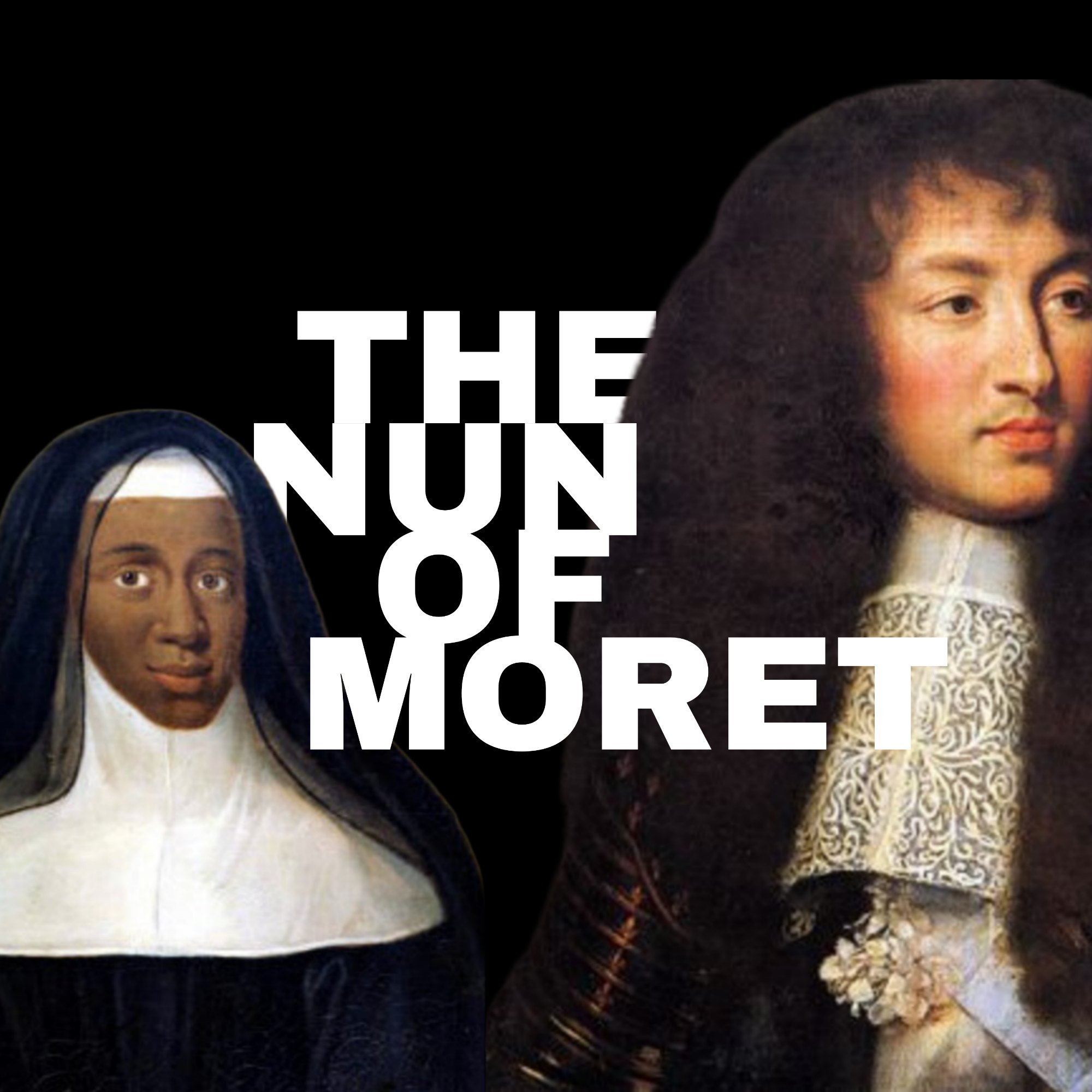
Introduction to the Controversy Surrounding Louis XIV’s Appearance

Do you know the name of this bubbly, eccentric early modern-era ruler? For history buffs, the over-the-top flair of this iconic extrovert should be instantly recognisable. Indeed, if you said, “I know that person—it’s most certainly King Louie or Ludwig the 14th,” you would be possibly, but not absolutely, correct. However, after this presentation, you may find any controversy regarding his appearance may lean more toward the subject of his identity than his bountiful hair. In recent years, startling discoveries continue to be made by researchers, uncovering surprising insights that force us to question the known depictions of the king and perhaps revise everything we think we know about modern-era history.
The Hidden Birth of Louise Marie Thérèse

So where to begin this tale? A possible starting point could be to review the hidden birth of a possibly illegitimate black child at the Petit du Parc in 1664. Louise Marie Thérèse, who bore both the names of King Louis and that of his wife, Queen Marie Thérèse, had a birth shrouded in controversy. In short, she was rumoured to be a love child belonging to either the king or his wife. This has inspired a wave of recent historical conspiracy and revisionism, fuelled by modern prejudices. Some questionable revisions are now weighted toward the theory that the child indeed may have belonged to the queen, with people suggesting an affair with a three-foot palace pygmy, Augustine, who was known as Nabo.
This might seem a far-fetched and ludicrous claim to the logical mind, but unfortunately, European historians have learned that any explanation is valid to explain away the inconvenient occurrence of Blackness among monarchs and nobility in history. If that wasn’t enough, some commentators have even suggested she was unknowingly inseminated at the hands of the playful imp, as he would spend extended lengths of time under her skirt. I kid you not—this conclusion has been seriously considered. Fortunately, however, we will be looking at the contemporaneous evidence more objectively and proposing a much more plausible explanation: an explanation reflecting the common belief at the time, which laid suspicion more firmly at the feet of the king himself.
Louis XIV: The Sun King’s Moniker and Legacy
King Louis XIV, or Louis the 14th, went by the moniker of the Sun King. Perhaps coincidentally, this title is also reflected amongst the Incas. In itself, it seemed to be quite a flamboyant and tropical title for a European ruler. Louis chose the sun as his personal emblem. According to Château Versailles, the sun, being the symbol of Apollo, god of peace and the arts, is also the star which gives life to all things, rising and setting with unfailing regularity. What perhaps did not fit this image was an illegitimate love child, and the suggestion of one will be substantially denied by those eager to preserve a more conventional narrative—not involving black children born out of wedlock—even if it means blaming it on the actions of a playful African pygmy.
Evidence Supporting the King’s paternal link to Louise Marie Thérèse
Do we have evidence for the version of events supporting the child belonging to the king? Well, first, there is the claim that, among other things, the king bore a startling resemblance to the child, which was noted by Voltaire in his works titled Le Siècle de Louis XIV (The Century of Louis the 14th). He states: “It was suspected with much likelihood that a nun of the Abbey of Moret was his (the king’s) daughter. She was extremely swarthy and resembled him. The king gave her 20,000 écus for a dowry, placing her in this convent.”
Here, we have evidence that the king supported her upkeep, suggesting quite clearly that he was taking personal responsibility for the child’s nurturing—something no male monarch would do for a child resulting from the acts of a philandering wife. His generosity to her is detailed in a letter sent on June 13, 1685, by the secretary of the House of the King to Mr. Dezon, General Agent of the Clergy, regarding the pension’s patent of £300 granted by King Louis XIV to the nun Louise Marie Thérèse on October 15, 1695, stating it was to be paid to her all her life in this convent or wherever she could be by the guards of the royal treasure, present and to come.
The Meaning of “Swarthy” and Its Implications


This brings us to the appearance of the child. She is described as swarthy, and not just swarthy—extremely swarthy. So what exactly does this frequently used word mean in context? For a definition, we can refer to Webster’s 1828 English Dictionary, which reads: “Being of a dark hue or dusky complexion; tawny. In warm climates, the complexion of men is universally swarthy or black. Their swarthy hosts would darken all our plains. Black as the swarthy African.”
In support of this definition, the 1827 Johnson’s Dictionary defines swarthy as “dark of complexion; black; dusky; tawny. The swarthy Africans complain. Though in torrid climates, the common colour is black or swarthy.” The definition of “swart” reads: “black; darkly brown; tawny. Of swart complexion, whereas I was black and swart before.” The definition of “swarthiness” reads: “darkness of complexion.”
As you can see, in contemporary literary citations, the definition of swarthy is consistently applied as a measure of complexion akin to Blackness and Africanity. Now, compare this with what we are led to believe about race relations between Europeans and Africans during that time period, and it becomes glaringly obvious that we are quite probably being grossly misinformed by the mainstream historical narrative.
Evidence Supporting the Noble Heritage of Louise Marie Thérèse
In addition to this, and even more surprisingly, Louise Marie Thérèse is stated to have resembled him because—and not despite—her swarthiness. To reiterate, Voltaire writes: “It was suspected with much likelihood that a nun of the Abbey of Moret was his (the king’s) daughter. She was extremely swarthy and resembled him.”
And as you can see, by all accounts, the child appears to be entirely—not partially—black, as one would expect from a mixed-race offspring. She was surely not the result of an affair between a wholly white monarch and an unnamed black “other.” Saint-Simon’s account of Louise Marie Thérèse reads: “It seems that in this convent there was a woman of colour, a Moorish woman, who had been placed there very young by Bonne, valet of the king. She received the utmost care and attention but never was shown to anybody. When the late queen or Madame de Maintenon went, they did not always see her but always watched over her welfare. She was treated with more consideration than people the most distinguished, and herself made much of the care that was taken of her and the mystery by which she was surrounded.”
Not only this, but even more tellingly, the locals seemed entirely unfazed by this rumour of the child’s heredity. Indeed, most were comfortably convinced that this black woman was indeed the daughter of the king. It was not only believed by the public but truly believed by Louise herself. Voltaire states: “Madame de Maintenon, on a trip from Fontainebleau, went to the convent of Moret and, wanting to inspire more modesty with this nun, she did what she could to debunk the idea which nourished her pride. Madame, the nun told her, ‘The trouble which a lady of your station takes to purposely come here in order to tell me that I am not a daughter of the king persuades me that I am.’ The convent of Moret still remembers this anecdote.” And what a believable quip it was indeed.
If the locals, along with this very black woman, were entirely convinced of her royal heredity, it certainly does bring into suspicion the ethnicity of either—or indeed both—the king and the queen of this late 17th-century French dynasty.
Portraits and Artistic Evidence

Indeed, a portrait of her still exists in the Château de Bréau Museum in Riron, simply named The Moor of Moret, and it’s confirmed to have been painted around 1680 by the same hand which painted the series of 22 pastel portraits of kings of France from Louis IX to Louis XIV between 1681 and 1683. Quite an honour for an illegitimate child indeed.
Let’s explore further literature and see what it suggests. For centuries now, eyewitness descriptions of the king describing his certainly melanated—at least by modern standards—appearance were largely ignored, as they plainly contradicted the abundance of portraiture clearly depicting him as anything but that. Indeed, King Louis XIV is a frequently illustrated individual with a somewhat peculiar but instantly recognisable look. But let’s see how eyewitness descriptions compare with these paintings of the so-called Sun King.
Historical Accounts of Louis XIV’s Complexion
Richard Wilkinson, in his biography of Louis XIV, describes him as follows: “So what did Louis XIV inherit from his parents? Actually, he most resembled his Bourbon grandfather. Louis XIV’s swarthy complexion and prominent nose were typically Bourbon.”
Once again, we can remind ourselves that swarthy translates to “darkness of hue,” “darkness of complexion,” or “black as an African,” if we’re to take the definitions from both Webster’s and Johnson’s early dictionaries literally.
In addition to this, in The Present State of Germany, published in 1738, it is said of the Habsburgs—the lineage from which Louis XIV descended through his mother, Anne of Austria—that “a swarthy complexion and thick, hanging lips (which last, as some will have it, is the distinguishing feature of the Austrian family).” These sentiments were repeated in The Life of Leopold, dated 1706, where the Habsburg nobles were once again described as having “a brownish complexion and the lower lip hanging down very much.”
Now, it’s fair to say the prominent terms used to describe his appearance—being swarthy, prominent-nosed, and possibly with thick and hanging lips—are quite notable. It’s also substantial that Wilkinson clearly makes reference to the entire Bourbon family line as being swarthy by stating these as “typically Bourbon” features.
The Bourbon Legacy and Its Implications
On a side note, the British biscuit Bourbon creams are a classic and favourite amongst biscuit lovers in the UK. They are possibly the UK’s darkest biscuit, being a deep, dark brown, dark chocolate biscuit. The interesting fact is they are not coincidentally named but rather got their name directly in relation to this particular royal lineage—similar to the family of dark brown spirits also referred to by the same name. But surely, this is all just a coincidence.


Let’s continue. James Peller Malcolm, in his 1802 work Londinium Redivivum, states: “Louis XIV had arched eyebrows, aquiline nose, and brown complexion.” Now, bear in mind, prior to the modern invention of race, it was entirely normal to describe someone literally by their physical appearance, with no aspersions of inferiority or even ethnicity tied to these descriptions.
Conjecture aside, there certainly seems to be a consistent theme forming—that being authors wanting to communicate the rich, full brown tone of his skin. Remember, swarthy was the same word used to describe his dark brown-skinned daughter, of whom we have portraits proving she was not the pale cream of her father’s alleged portraits that some are trying to attribute to the word.
On reflection, it seems these portraits of the king are clearly incompatible and cannot possibly be attributed to these descriptions. Shall we continue?
Posthumous Descriptions of Louis XIV
Sir Richard Phillips, in The Monthly Magazine, Volume 13, published in 1802, states of the corpse of Louis XIV: “Louis XIV was also in good preservation, but his skin was as black as ink.”
Now, to be clear, there is no question that the skin of the deceased is likely to change tone, and this description of the king was taken posthumously—that is, after his death. However, even with that in mind, a description of “black as ink” seems to be a very extreme expression of petrification for one who in life was depicted as considerably pale. However, for one who in life had swarthy skin, this change in skin tone seems reasonable, if not expected.
With that in mind, as it stands, there seems to be somewhat of a literary consensus about the brownness of the king’s complexion that is entirely unrepresented in his publicised portraiture—which I’m sure you’d agree is bizarre. However, just that observation, even alongside the extreme swarthiness of his daughter alone, is not enough to rewrite the history books.
The Mysterious Portrait by Jacint Rigau Ross Serra
Are there any more turns in this tale that can paint a more agreeable picture of the king’s appearance—turns that perhaps are confluent with the contemporary literature? Well, it’s at this point that this story gets even more interesting.

This portrait remains one of the earliest known extant portraits of a so-called black man in French painting. It was painted by Jacint Rigau, a French painter of Catalan origin, around 1679. Coincidentally, this would have made the official age of Louis XIV around 41 years old at the time of its creation.
Interestingly, Rigau was a French Baroque painter famous for portraits of Louis XIV himself, among other royals and members of the Habsburg nobility, and was certainly the most prolific portrait painter during the reign of King Louis XIV. He is considered one of the most notable French portraitists of the classical period. Rigau owes his celebrity to the faithful support he received from the four generations of Bourbons whose portraits he painted—namely, King Louis XIV being perhaps the most notorious.
Modern curators have simply classified this as a portrait of Balthazar since, as is the trend, the sitter’s swarthiness has relegated them to total anonymity. Unfortunately, black subjects rarely, if ever, retain their true identity.
Now, this image by itself is unremarkable in terms of assuming an identity for the king, besides the fact it was painted contemporaneous to his reign by his favoured artist. However, if we revisit the claim by Voltaire—that his daughter Louise Marie Thérèse, the nun of Moret, was extremely swarthy and resembled him—then things do get more interesting.
The Resemblance Between The Unknown Sitter and The Nun of Moret


The claim being that his daughter Louise Marie Thérèse, the nun of Moret, was extremely swarthy and resembled him. In view of that, suddenly this portrait takes on a different light. For although she bears no resemblance to publicised portraits of the Sun King, the resemblance to this painting would immediately provide the context for the stated familiarity and the rumours of relation that were accepted as fact by the locals.
With a detailed observation of the works beyond them both being of a similar hue—which is not remarkable at all—one can observe that they have an incredibly aligned phenotype, observable in the eyes, nose, and lips being strikingly similar. One could declare a familial resemblance would not be an incredible claim.
Let’s compound that with the multiple descriptions of the king that we have already visited upon: his deep brown, swarthy complexion; his prominent nose; and the hanging lips possibly inherited from his mother’s lineage; even the blackness of his corpse—all become instantly contextualised and reasonable.
Could this unnamed sitter, painted by King Louis XIV’s favourite portrait artist, actually be Louis XIV himself?
The Moorish King Depictions and Noble Genealogy


Moorish King

His appearance may seem peculiar, particularly in this turban, but the depiction of nobles as Moorish kings appears to have been widespread at the time. Modern interpretations have claimed these are all depictions of black Magi, but the Metropolitan Museum of Art describes this outfit as that of a Moorish king and not a Magus.
In fact, there are numerous portraits and busts dating to the late 17th century, contemporaneous to Louis XIV, showing unnamed Moorish royals wearing almost identical outfits to the one shown in this painting. These busts, ranging from many miniature to more than life-sized, are largely concentrated in the Italian region.
Could this be Louis XIV’s homage to a possible Moorish genealogy? This would be consistent with coats of arms of numerous noble lineages depicting Moors’ heads, suggesting the genealogy of many of Europe’s nobles had Moorish—or at least dark-skinned—origins.
The Armour of Louis XIV and Its Implications in this Tale

There’s even more to support this suggestion. In this famous painting of the king, painted by the renowned Hyacinthe Rigaud, we see him wearing his very unique armour, punctuated by the emblems of the sun on the breastplate, with breast articulation styled in the manner of emanating sun rays. This armour was likely designed for the king as an homage to his symbolic role as Sun King.
However, and interestingly, there is another painting where identical armour is being worn. Little or nothing is known about the sitter in this portrait. He is simply called The Mulatto, as is the case with most black or mixed persons of nobility—he has been stripped of his name. But we’ve already discussed that.
How then can we assert his nobility, if indeed he is a noble at all? Well, certainly, the ability to commission a painting of this detail was beyond the means of the general public. But more notably, the armour he wears raises big questions.

We know that by the 16th century, according to Donald LaRocca in his book How to Read European Armour, royal workshops made armour only for the sovereign and members of the court by royal warrant. So, armories supplying the royals did not supply the general public.
We also know that by this period, in order to be bulletproof, the thickness—and therefore the weight—of plate armour became impractical to wear, causing it to go out of use by the end of the 17th century. And this lack of utility meant that ceremonial armour was designed for visual impact, to convey luxury and status, rather than for protection.
In light of this knowledge that armour played a significant role in both identification and ceremony for the monarch who commissioned it, one can assert that it was unheard of for monarchs—who only donned this type of quasi-ceremonial armour ceremonially—to ever share it, as an impossibility, let alone with someone not of immediate nobility.

So just who was this sitter, and why does he share the armour of Louis XIV?
The Uncanny Resemblance Between Portraits
And that’s not all. Another important observation is that when placed alongside the portrait in question, we once again are faced with quite an impactful resemblance—so close, one would not be amiss to assume a familial relationship existing between the two subjects.

What’s more intriguing about this portrait is how naturally his hair seems to be in that Baroque royal hairstyle. No longer does the hair look like a bizarre, ill-fitting quirk, but instead, it now falls naturally in both texture and style to the phenotype of the subject.

Can you suspend your disbelief briefly and assume that this image presented could be the real face of a Bourbon royal? Could this leap of faith actually provide a logical explanation for the puzzling and conflicting data we hold about the Sun King?
The Final Piece: A Portrait of a Later Bourbon?

Our final piece of evidence lies in this portrait, presumably painted by Marie-Victoire Lemoine in the late 18th century. Once again, the sitter is unknown, but people have suspected this is another Bourbon royal—this time, possibly Louis XVI or his son, the tragic boy-king Louis XVII.
Similar to the portraits we have already discussed, this portrait has a strikingly close proximity to the royals in terms of its date of creation. The sitter, who in this case could be grandson or great-grandson of Louis XIV, looks as one would expect a direct descendant to look.
In fact, if one places these portraits—penned by different artists, in different locations, at different moments in history—side by side, the resemblance between them is both exciting and somewhat unsettling.

Conclusion: Reassessing Louis XIV’s Identity
Now, obviously, this could all be chalked up to nothing but coincidence. But what a peculiar set of circumstances to present us with such evidence.
- In order to believe that King Louis XIV was exactly who we have been told he is, one has to believe that not only were the eyewitnesses blind, they were also slanderous and treasonous. After all, we have been fed the narrative that “blue blood” among the monarchs of Europe demands the absolute palest of complexions, obtained through purity of lineage. And yet, eyewitnesses and biographers are freely describing them with a word contemporaneously used to describe dark people of African descent.
- Equally, we have to believe the entire population who saw validity in the suspicion of the rumour of a black love child were unable to discern the impossibility of a black baby being born to a lily-white or even interracial couple.
- We have to believe it was normal for random people of black or mixed heritage to be allowed to don the king’s armour for a portrait.
- We also have to believe the portraits created by royal portrait artists just so happened to depict people who bore uncanny resemblances to one another, despite being separated by decades and painted by different artists. They also just happened to look like the king or queen’s illegitimate daughter.
Such an astounding set of coincidences has brought us to this point, where we are considering this completely insane theory. But the evidence does make it one that you can’t pass up without at least exploring the possibility.

Leave a Reply