
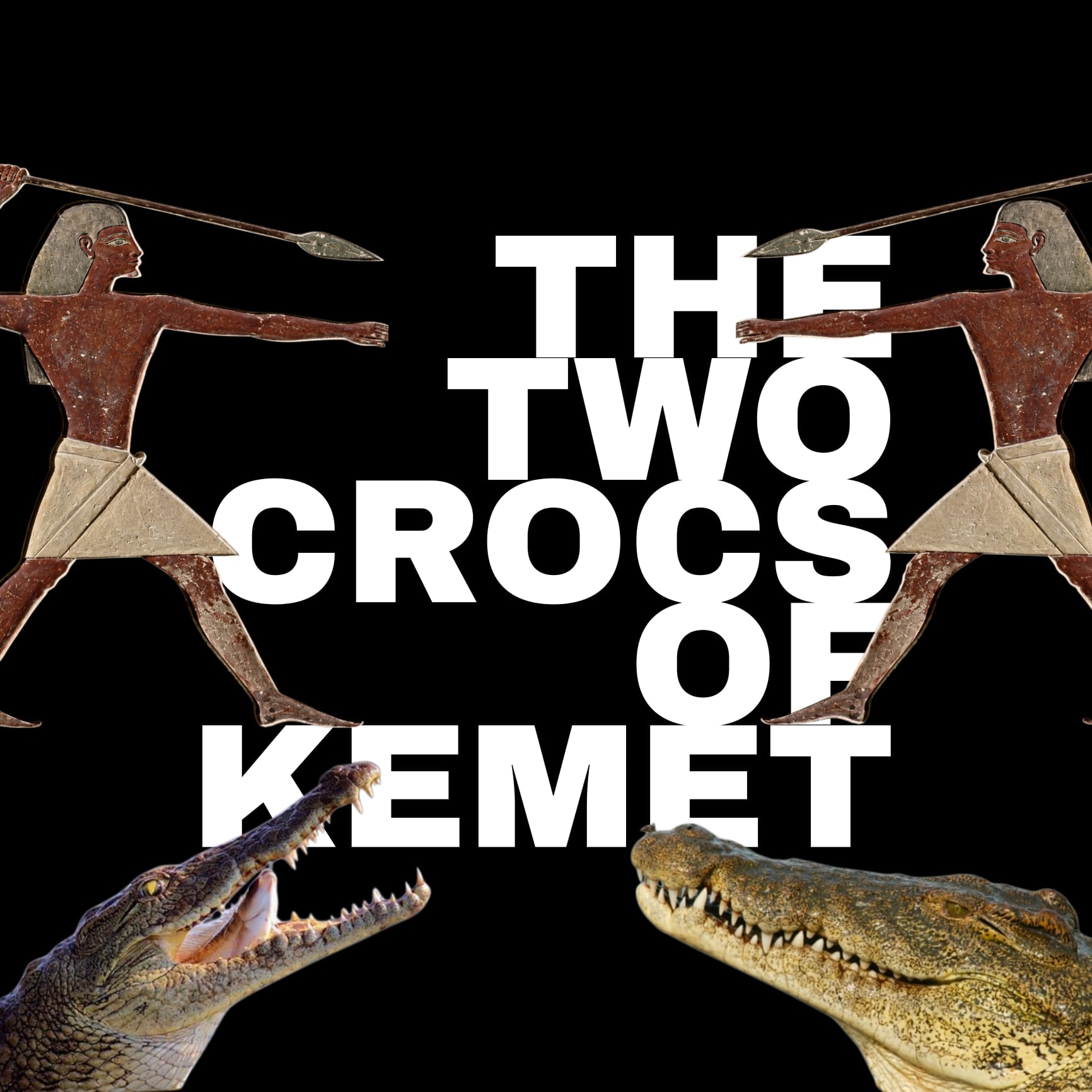

Pliny the Elder described a people who dared to attack the crocodile by mounting its back like horsemen. For centuries this account, along with a similar report from Strabo, was treated as travellers’ fable. No historian could locate the city these writers named, and no scholar could explain how any population might safely handle an animal long regarded as the most fearsome predator of the Nile. Yet the tribe was real, the city has since been identified, and the natural history behind the story is more precise than either Greek or Roman author understood. The key to unlocking the account lies not in mythology but in zoology: ancient Kemet was home to two distinct species of crocodile, and its population knew the difference long before modern science caught up.
Two Crocodiles, One River
For decades, researchers studying the Nile treated its crocodile population as a single species, Crocodylus niloticus, with variation in size and temperament dismissed as ordinary biological range. This assumption collapsed in 2011, when a genetic study of mummified crocodile remains from ancient Egypt revealed that the Nile had in fact supported two separate species throughout the pharaonic period.


The first is the large, aggressive Nile crocodile, Crocodylus Niloticus, a south-east African species and, unexpectedly, a closer genetic relative of the American saltwater crocodile than of its West African neighbour. The second is the smaller, notably calmer Crocodylus Suchus, native to Central and West Africa, here referred to as the Niger crocodile. Despite occupying the same river system as Crocodylus Niloticus, genetic analysis shows the Niger crocodile is more distantly related to it than either is to unrelated lineages an ocean away, a striking illustration of how genetically diverse the African continent’s fauna has always been.


The presence of a Central and West African species in the Nile is not incidental. It points toward an old hydrological link between the Nile basin and the river systems of West Africa, an intra-Saharan network proposed in ancient texts and marked on the maps of several medieval and classical cartographers. The Niger crocodile’s range, extending from the Nile Valley across the Sahelian belt to the West African coast, and its presence in caves as far west as Mauritania, is difficult to explain without some historical corridor connecting the two regions.
What is not in dispute is that the ancient Egyptians themselves recognised the distinction. Herodotus recorded that the Egyptians identified one crocodile as large and aggressive, and another as tame and sacred, kept and raised within temple precincts. This matches the archaeological record precisely: Crocodylus Suchus, the Niger crocodile, is the species found almost exclusively within Kemetic temples and tombs, while the more dangerous Crocodylus Niloticus appears in contexts of conflict rather than worship.
Temperament, Not Superstition
The reputational gap between the two species was not a matter of ancient superstition but of observable behaviour. Crocodylus Niloticus is a formidable predator, second in size only to the Indo-Pacific saltwater crocodile, Crocodylus Porosus. It shows no deference to man or beast and treats all living creatures within its range as potential prey.
Crocodylus Suchus, by contrast, was long mischaracterised by modern scientists as sluggish. In reality it possesses a comparatively affable, approachable temperament, distinct from its Nile-dwelling relative. This is almost certainly why it was the species selected for domestication and temple use, becoming a sacred animal across the entire Nilo-Saharan and Sahelian basin, from the Nile Valley to the West African coast. Palaeolithic and Neolithic populations along the Nile likely encouraged its spread through precisely these traits, favouring a species that could be handled, bred and incorporated into ritual life.


Genomic evidence supports active, deliberate breeding of the Niger crocodile for mummification and other ritual purposes, rather than passive capture of wild individuals. The scale of this practice is visible in the archaeological record. A crocodile cemetery at Tebtunis contained thousands of mummies of the West African variety, a volume that points toward commercial-scale breeding rather than opportunistic burial. This is reinforced by the discovery at Narmouthis in the Faiyum of two buildings functioning as a crocodile nursery and hatchery, evidence of an institutionalised breeding programme operating in at least one Kemetic town.
The cult centre for this veneration was Crocodilopolis, later known as the Faiyum, where a Greek-influenced population worshipped the crocodile-headed god Sobek under the name Suchus, a Hellenised form of the Kemetic deity’s name. It is from this that the species name Crocodylus Suchus derives. Sobek’s popularity peaked during the Greco-Roman period, between 332 BCE and 395 CE, and for Kemetic priests the crocodile-headed god embodied the fluid, unpredictable character of the Nile itself, invoked for protection from the river’s annual floods.
Tentyra: The City That Hunted the Sacred Beast


Reverence for this ancient reptile was never universally applied in Kemet. In other cities, particularly those where the large and menacing Crocodylus Niloticus predominated, crocodiles were regarded for their prowess rather than their divinity, causing the population to suppress the creatures more than venerate them. One such city, known for a particular mastery of crocodile taming, was the mysterious city of Tentyra, and this seeming hostility was remarked upon by Strabo.
Strabo’s own account, describing the Tentyrites of the district of Apollinopolis, reads as follows:
“Apollinopolis is a district of the Tentyrites, and these people detest the crocodile. They kill the crocodiles for sheer contempt of them, and the animal is afraid even of the smell of the Tentyrites. These Tentyrites know various ways to kill the crocodile, and they even ride it as a horse by jumping on its back. They swim freely in waters infested with crocodiles, because the crocodiles never dare attack them.”
Although this observation may have lacked context, causing the observer to fall prey to exaggeration, the account is echoed by Pliny the Elder, who gives a fuller record of the same tribe:
“There is a race of men also, who are peculiarly hostile to this animal; they are known as the Tentyritæ, from an island in the Nile which they inhabit. These men are of small stature, but of wonderful presence of mind, though for this particular object only. The crocodile is a terrible animal to those who fly from it, while at the same time it will fly from those who pursue it; these, however, are the only people who dare to attack it. They even swim in the river after it, and mount its back like so many horsemen; and just as the animal turns up its head for the purpose of biting them, they insert a club into its mouth, holding which at each end, with the two hands, it acts like a bit, and, by these means they drive the captured animal on shore. They also terrify the crocodile so much by their voice alone even, as to force it to disgorge the bodies which it has lately swallowed, for the purpose of burial. This island, therefore, is the only place near which the crocodile never swims; indeed, it is repelled by the odour of this race of men, just as serpents are by that of the Psylli.”
For a long time, the Tentyrites were treated as a semi-legendary people, since no historian could locate the city Pliny and Strabo described. That uncertainty has since been resolved. Tentyra, rendered by the Greeks as Tentyris or Tentyra, is simply the Hellenised name for the well-documented Kemetic city of Dendera, known to the ancient Egyptians as Iunet, located on the west bank of the Nile roughly sixty kilometres north of Luxor. The accounts of Strabo and Pliny were not describing a lost or mythical settlement. They were describing Dendera, a city whose temple complex remains one of the best-preserved in Upper Egypt.
A Roman-Era Portrait of a Crocodile Rider


The identification of Tentyra as Dendera is reinforced by material evidence that has, until now, been catalogued without reference to this history. In the first century CE, Roman artists produced a life-sized limestone statue depicting a figure in the act of subduing a crocodile. It is currently held in the British Museum, labelled simply as an African acrobat on a crocodile, a member of the Tentyritae tribe.
Understood correctly, this statue is a first-hand Roman-era depiction of an indigenous citizen of Dendera, captured in the very act Pliny described: mastering and subjugating the crocodile by physical force. It stands as material confirmation of the literary record, translating Pliny’s written account directly into stone.
The statue is also consistent with the wider body of Roman-period portraiture of Egyptians produced across the first century CE. These figures are shown wearing the nationally recognised Kemetic short twist hairstyle, display distinctly Nilotic facial features, and are unmistakably African in appearance, a detail worth stating plainly given how frequently such Roman-era Egyptian portraiture has been stripped of its African context in later reproduction and display.
Unbroken Practice: The Nubians of Aswan


But beyond bringing in tourist dollars, crocodiles play an important role in the culture of the Nubian community, an ethnic group with a history dating to Pharaonic times and its own unique language. (Photo by Khaled DESOUKI / AFP)
The assumption that Kemetic culture ended with the close of the pharaonic period does not survive contact with the archaeological and ethnographic record. Much of it has never stopped being practised. Nowhere is this more evident than among the Nubians of southern Egypt and northern Sudan, a population that continues to speak a language and maintain cultural practices directly descended from ancient Kemet, in spite of losing more than ninety per cent of their historic homeland to twentieth-century dam construction along the Nile.


Among the customs the Nubians of Aswan have preserved is the breeding, domestication and ritual treatment of the crocodile. A twelfth-dynasty bas relief depicting Amenemhat spearing a crocodile bears a striking resemblance to photographs of Nubians capturing crocodiles taken in 1880, a visual continuity spanning roughly four thousand years.


A temple dedicated to Sobek at Kom Ombo is engraved with pictograms and hieroglyphic inscriptions detailing the embalming of crocodiles in antiquity, and Nubian communities today maintain a taxidermy tradition that follows the same centuries-old technique.
According to Mamdouh Hassan, a local practitioner, crocodile leather is never sold despite its commercial value, because the community values the life force of the animal above its material worth. The mummification process involves skinning the carcass and filling it with straw or sawdust. A large crocodile takes roughly a month to prepare in this manner, while a smaller one dries within a few days.
In a formulation that closely echoes the theology of Sobek worship at Crocodilopolis two thousand years earlier, one Nubian resident describes the Nile as representing life itself, with every creature that roams within it considered akin to an angel. The crocodile, in this framework, is bred, adorned, venerated, tamed and cherished as part of an unbroken African tradition spanning several millennia.
West African Parallels: Bazoule and Paga


The continuity does not end at the Nile Valley. Travelling west across the continent, the same relationship between humans and Crocodylus suchus reappears in the small present-day villages of Bazoule in Burkina Faso and Paga in Ghana. Both are home to established populations of crocodile handlers who interact with, and in some cases ride, the same species once bred and mummified in Kemetic temples, the very Crocodylus suchus whose Nile population first suggested a lost hydrological link to West Africa.


Bazoule and Paga continue the old, gentle thread traced earlier in this article: the domestication and veneration of Crocodylus Suchus first practised in Kemetic temples. The crocodiles approached in these villages are reared, fed and revered rather than hunted, and that reverence sits closer to the cult of Sobek and the practice of the modern Nubians of Aswan. It represents another instance of a pattern that recurs throughout the study of African cultural continuity: a practice recorded in classical antiquity, assumed lost, persisting quietly and independently across widely separated regions of the continent, more than two thousand years after Greek historians and Roman sculptors first documented the wider Kemetic relationship with the crocodile.
Conclusion
In another beautiful example of cultural retention, one can still find the culture of ancient Kemet alive and well on the African continent, more than two thousand years after the acrobatic exploits of the Tentyrite tribe were recorded in detailed written word by Greek historians, and illustrated magnificently in stone by Roman artists.

The author, Andrew A. King BSc PGCE QTS is a qualified educator, creator and thought leader who is playing a leading role in redefining the participation of indigenous Africans in the development of the history of Black people in global history.


Leave a Reply