
The King’s Monologue | 2026
The Controversy That Isn’t Really About History

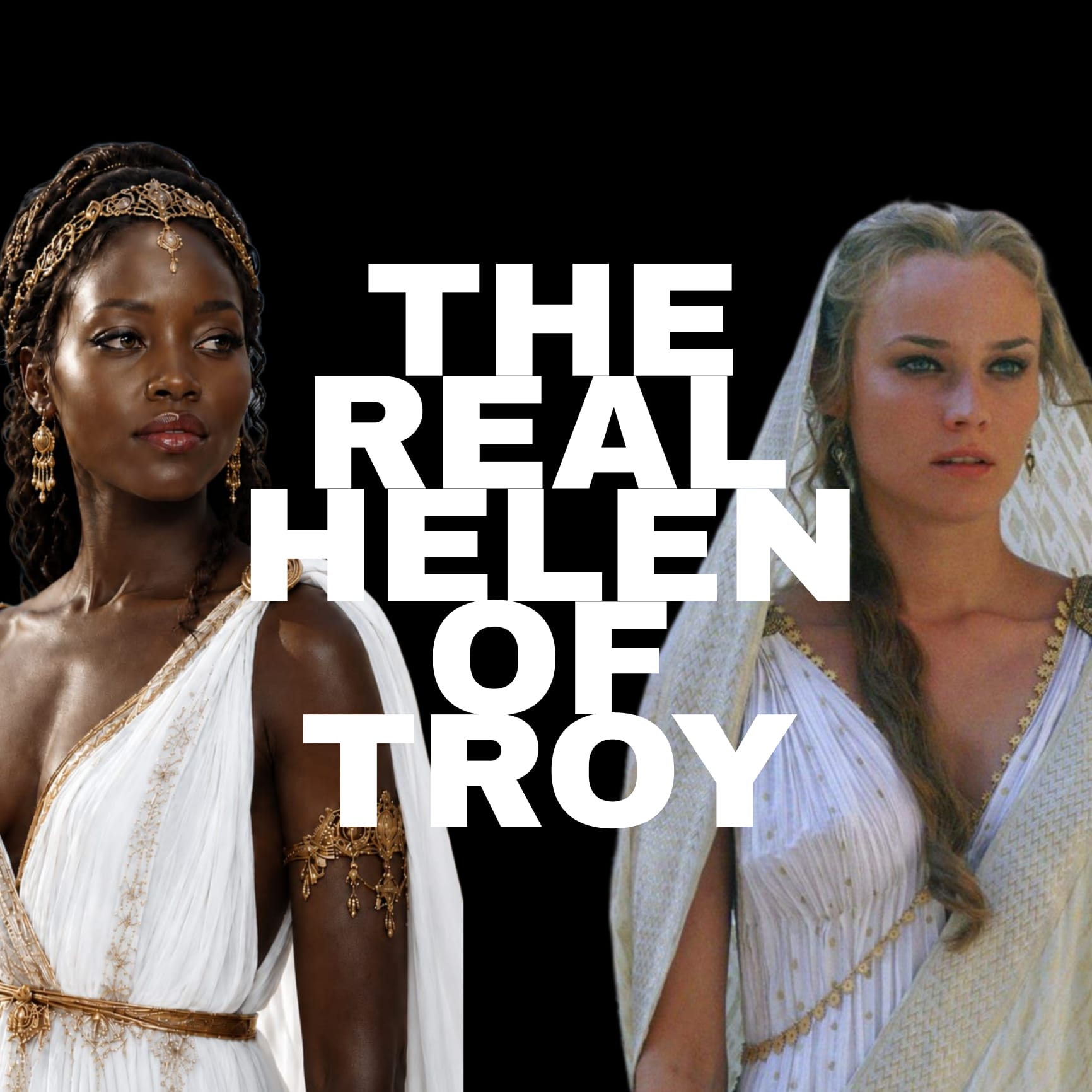
When Christopher Nolan’s upcoming adaptation of The Odyssey was announced with Lupita Nyong’o cast as Helen of Troy, a predictable wave of online outrage followed. Self-styled historians, content creators, and cultural commentators rushed to declare the casting a violation of historical accuracy, an act of ideological sabotage, a betrayal of the source material. The complaints multiplied. The videos multiplied. And with them, the language grew uglier.
But if you strip away the noise, one question stands at the centre of all of it: could a dark-skinned African woman plausibly represent Helen of Troy?
The answer, when examined through the actual literary and historical record, is considerably more complex than the outrage merchants would have you believe. And on several key points, the evidence does not merely permit the casting. It actively supports it.
Let us be precise about what this discussion is and is not. The argument here is not that ancient Greece was a Black civilisation. It is not a simple racial inversion. The argument is that ancient Greece venerated African civilisation, drew its gods directly from African sources, placed the homes of those gods on African soil, and depicted those gods with black skin. And that the father of Helen of Troy was one of them.
What The Odyssey Actually Is


Before engaging the historical arguments, it is worth addressing a foundational issue that the critics consistently avoid. The Odyssey is Greek mythology. It is not a documentary. It is not an ethnic census. It is a narrative tradition built on fictional and semi-divine characters, assembled from oral traditions spanning centuries, and bearing only an indirect relationship to any historical population.
The overwhelming majority of modern audiences who claim emotional investment in the ethnic purity of its characters encountered those characters through the 2004 film Troy, not through Homer. Before Hollywood standardised the blonde Achilles and the German Helen, these characters existed primarily in the minds of classical scholars and a narrow enthusiast community. The sudden urgency to defend their “historical accuracy” is telling.
When content creators produce video after video insisting that casting a Black woman in the role of Helen is an affront to history, and then in the same breath acknowledge that the controversy is really about audience “immersion,” they have already conceded the argument. Immersion is not history. Immersion is conditioning. It is the accumulated effect of decades of cinematic choices that placed Nordic aesthetics onto Mediterranean and North African settings, and trained audiences to mistake that habit for fact.
Furthermore, Helen’s role in The Odyssey specifically, as opposed to The Iliad, is minimal. Those alleging that her casting will derail the narrative clearly have not read the text they claim to be defending.
The Double Standard on Historical Accuracy


The argument that the casting of Lupita Nyong’o violates historical accuracy collapses immediately when placed against the record of what Hollywood has actually done.
Alexander the Great, a Macedonian ruler, was played in Oliver Stone’s 2004 film by an actor whose natural dark hair was bleached platinum blonde for the role. The actual Alexander mosaic from Pompeii, one of the very few near-contemporaneous visual references, depicts someone with no resemblance to the Nordic ideal. Colin Farrell’s natural colouring would have been a considerably closer fit. The decision to make him blonder was not historical accuracy. It was historical revision.
Gods of Egypt cast white actors in roles depicting ancient Egyptian deities, including figures understood in the Kemetic tradition to be ancestral and African. The Mummy franchise has done likewise for generations. There is not a single non-European ethnicity that has not been portrayed by white actors in film, complete with English accents, in service of what passes for historical representation on screen.


More recently, Gladiator II featured Caracalla, the son of Septimius Severus, a North African emperor whose portrait survives in the Severan Tondo as an unmistakably dark-skinned individual with tight curled hair. The Fayum mummy portraits, painted by artists working in the region during the Roman period and showing people of Hellenic ancestry, further establish the typical phenotype of Mediterranean Africans in that era. Caracalla was cast as a pale, red-haired individual with white powder applied to his face, apparently to enhance the effect. No outrage followed. No videos demanded historical accountability.
The standard is not being applied consistently. It is being applied selectively, and the selection criterion is transparently racial.
The Aegean Has Never Been Whiter


One of the foundational errors in the discourse around ancient Greek ethnicity is the assumption that the Mediterranean region has remained constant in its demographics, or that the ancient populations resembled modern northern European aesthetics.
The reverse is true. The Aegean has grown exponentially whiter since the time of Homer, not darker. The population movement runs in that direction. Claims that blonde, blue-eyed peoples were native to North Africa or the ancient Mediterranean not only lack evidential support. They contradict what biology and climatology tell us about survival in equatorial and semi-equatorial environments.


Modern Egyptians, Libyans, Berbers, and their ancestors did not develop their melanin through some later incursion or contamination. They are indigenous to that region. The idea that the ancient population of the Sahara or the Mediterranean coast was paler than its current inhabitants is biologically unsupportable. And yet this is precisely the narrative being advanced by those who insist Helen of Troy must resemble someone from northern Germany.

Ancient Greece itself, occupying a middle position between Africa and northern Europe, was a mixed Mediterranean civilisation. The ancient Greeks were acutely aware of their position. They said so, explicitly and repeatedly.
What the Ancient Greeks Thought About Northern Europeans
The critics demanding Nordic-looking Helens apparently have not read what the ancient Greeks actually wrote about the people of northern Europe.
In Titus Andronicus, Shakespeare represents the Roman view of the Germanic Goths as savage enemies from the north. This is consistent with the ancient Greek and Roman understanding: the Goths, the Germanic tribes, the Thracians, were regarded as barbaric peoples on the periphery of civilisation. Their physical appearance, including the very blonde hair and blue eyes now being proposed as the ideal template for Hellenic beauty, was associated not with nobility but with savagery and crudeness.
Ancient critics and classicists have been clear: a figure like Sydney Sweeney, frequently offered as a racially correct alternative to Lupita Nyong’o, would have been regarded in ancient Greek aesthetic terms not as the pinnacle of beauty but as an object associated with barbarism. Her phenotype, tall, lean, blonde, and blue-eyed, corresponded in the ancient Greek imagination to the feared and despised peoples of the north. The idea that this is what Helen of Troy should look like is a product of modern media conditioning, not classical scholarship.
Aristotle in Politics 7.7 distinguished three racial groups: the peoples of cold northern Europe, whom he regarded as spirited but lacking in intelligence and political capacity; the peoples of Asia, whom he found intelligent but lacking in spirit; and the Greeks themselves, whom he placed deliberately between both, partaking of qualities from each. At no point did the Greeks align themselves with northern Europeans. At every opportunity, they differentiated themselves.
The Idiomatic Use of “White-Armed”

One of the primary textual arguments advanced by those insisting Helen was white rests on the Homeric epithet leukōlenos, meaning “white-armed,” which appears multiple times in the Iliad. But this argument cannot survive serious linguistic examination.
The Greek term leukos does not function in Homeric literature as a strict racial descriptor. Depending on context, it can mean bright, shining, fair, pale, radiant, light-toned, pure, or virginal. It carries connotations of untouchedness, softness, and purity rather than a specific skin colour category in the modern sense.
More critically, the epithet “white-armed” is never applied to men in Homer. Not to Achilles. Not to Odysseus. Not to any male character in either the Iliad or the Odyssey. It is applied exclusively to elite women and goddesses. This distributional fact alone undermines any racial interpretation. If the phrase described skin colour, we would expect it to appear wherever fair-skinned characters appear, regardless of gender. Its restriction to women of rank strongly suggests it is functioning as a status marker, one denoting softness of skin, freedom from outdoor labour, and noble delicacy, rather than as a statement about complexion.
The Odyssey itself provides the decisive refutation. When Athena places Odysseus in disguise, she “wrinkles the fair skin on his supple limbs” and destroys his appearance. When she restores him, the text states plainly that “once more he grew dark of colour,” using the word melas, which unambiguously denotes blackness or darkness. The word “fair” used in the disguise passage clearly did not describe his natural colour, since his restoration to natural appearance is explicitly described as a return to darkness.
This means that if leukōlenos applied to Helen constitutes proof that she was white, then the use of melas applied to the restored Odysseus constitutes proof that he was black. One cannot accept one reading while rejecting the other. Either the Homeric colour vocabulary is consistently literal, in which case Odysseus is black, or it is contextually figurative, in which case “white-armed” tells us nothing definitive about Helen’s ethnicity.
Helen’s Parentage: Zeus and the Question of Divine Blackness


The most important genealogical fact about Helen of Troy is that she is consistently identified in Homer as the daughter of Zeus.
In Iliad 3.199 and 3.426, she is called a child of Zeus and the daughter of Zeus respectively. In Odyssey 4.184, she is described as “sprung from Zeus.” Homer places her divine parentage through Zeus far more prominently than through her mortal mother Leda, who is barely mentioned in the Homeric texts and requires later Greek literature for elaboration. Helen is presented first and foremost as a demigoddess, a being of divine ancestry.
This is not incidental. It is essential. Because if we want to understand who Helen of Troy would have looked like to an ancient Greek audience, we must understand who Zeus was to that audience. And the evidence on that question is striking.
Zeus Was African

The identification of Zeus with the Egyptian god Amun or Amen is not a modern invention. It is a documented feature of ancient Greek religion.


Alexander the Great’s famous visit to the oracle of Amun at the Siwa oasis, where he was declared son of Zeus-Ammon, was understood by the Greeks themselves as a confirmation of the equivalence between their own supreme deity and the Egyptian Amun. The Greeks did not regard this as a foreign association. They embraced it. They called Amun by the name Zeus. They treated the temples of Amun as temples of Zeus.


Amun was not simply an Egyptian deity. Ancient Egyptian tradition itself acknowledged that Amun was originally an Ethiopian or Kushite god, inherited by the Egyptians from the south. The Theban dynasties, based in upper Egypt near the Sudanese border, were the primary cult centre of Amun. The city that served as the home of Zeus in the ancient Greek naming system was Diospolis Magna, meaning the Great City of Zeus. That city is Thebes in upper Egypt, in the deep south of the Nile Valley.


The Greeks knew this. They named it. They built on it. And Zeus was not merely associated with Egypt through administrative geography. He bore an epithet that makes his African identification explicit: Zeus Aithiops, meaning Zeus the Ethiopian, or Zeus the Burnt-Faced. This appellation appears in Lycophron’s Alexandra (537), dated to the third century BCE. It is confirmed by the Byzantine commentator John Tzetzes in the twelfth century CE, who recorded that Aithiops, meaning “the glowing or the black,” was a surname of Zeus on the island of Chios, the fifth largest island in the Aegean and a significant cultural centre.

The island’s proximity to the African cultural sphere through trade and cultural exchange is not incidental. And crucially, Zeus is never called Zeus Leukos, the white, or Zeus Leukōlenos, the white-armed, in any attested source. His divine epithet connects him to Africans, to Ethiopians, to burnt-faced divinity. The same appellation applied to the Ethiopian king Memnon, a figure in the Iliad, confirms that Aithiops functioned in the Greek imagination as a descriptor of black African identity.
The Greek Gods Came From Africa: The Manethan Tradition

Herodotus, writing in the fifth century BCE, stated plainly in his Histories (2.43-53) that “almost all the names of the gods came into Greece from Egypt.” This is not a fringe claim. It is a statement by the man frequently called the father of Western historiography, made at a time when Greek civilisation was at its height.


The Manethan king list, compiled by the Egyptian priest Manetho in the third century BCE, preserves a pre-dynastic lineage for ancient Egypt that reads like a Greek pantheon. The first rulers of Egypt in this tradition include Hephaestus, Helios, Cronus, Osiris and Isis, Typhon, Horus, Anubis, Heracles, Apollo, Ammon, Thoth, and Zeus. The correspondences are not approximate. They are systematic.
The connections between specific Egyptian deities and Greek equivalents are documented across multiple ancient sources. Hephaestus corresponded to Ptah. Helios to Ra. Cronus to Geb. Osiris remained Osiris. Typhon to Seth. Horus to Horus. Hermes to Thoth. Dionysus to Osiris in a second manifestation. Athena to Neit.

The Athena-Neit connection is documented by Plato in the Timaeus (21e-22a), where the Egyptian priests of Sais tell Solon that the founder of their city is a goddess whose Egyptian name is Neit, “but whom the Greeks call Athena.” The Greek original preserves the identification explicitly: hēn dē tē̂i mèn Aiguptíāi phōnēi̇ Nēïth, Hellēnistì dè Athēnân kaloûsin, meaning “she whom in the Egyptian tongue they call Neith, but in Greek Athena.” This was written circa 360 BCE.
The argument that Greece borrowed its gods from Africa is not a modern revisionist claim. It is what the ancient Greeks themselves recorded, in their own literature, at the height of their civilisation.
The Homes of the Greek Gods Were in Africa

Perhaps the most striking evidence for the African origin of the Greek pantheon is geographic. The ancient Greeks named cities after their gods. And when they named the greatest cities, the magna cities, after those gods, they placed them overwhelmingly in Africa.
Heracleopolis Magna, meaning the Great City of Heracles, is in Middle Egypt. There is no older or more significant Heracleopolis anywhere in Greece or the Aegean world.
Hermopolis Magna, the Great City of Hermes, is also in Egypt. A later Greek Hermopolis existed in the Aegean region, but the Egyptian city is older, and it alone bore the appellation magna.
Diospolis Magna, the Great City of Zeus, is Thebes in upper Egypt, near the Sudanese border. The Greek city of Thebes is younger than its Egyptian counterpart and was never accorded the same designation.
Apollonopolis Magna, the Great City of Apollo, is Edfu in upper Egypt. Again, no Greek Apollo cult city carries the magna title.
Aphroditopolis, associated with the goddess Aphrodite, is in Middle Egypt, corresponding to the Egyptian Hathor, from whom Aphrodite was derived through the name Hetheru.
These are not marginal cult sites. They are the cities the Greeks themselves designated as the principal homes of their principal deities. When the ancient Greeks wanted to identify where their gods were from, they pointed to Africa.
The Black Founding of Athens


The founding of Athens itself has African dimensions that the ancient Greeks acknowledged without embarrassment. The Argive, or Heraclid dynasty, traced its lineage through Heracles, who was in turn derived from the Egyptian deity Heryshaf. Heracles’ city was in Middle Egypt. His mythology is thoroughly African in genealogy.
The tradition of Cecrops, regarded by the Greeks as the mythological founder of Athens, has been connected by scholars working in the traditions of Greek mythology to Senusret I, the founder of the Twelfth Dynasty of ancient Egypt. The Greek name Cecrops reflects the Egyptian throne name Kheperkara. This is not fringe scholarship. The ancient Greeks themselves preserved the memory of Greek city-states being founded by Egyptian rulers. They acknowledged it as part of their own heritage.
The Archemenid dynasty similarly claimed descent from Egypt through multiple lineages. The connection was known, documented, and celebrated rather than concealed.
The Depiction of Black Divinity in Greek Art

Ancient Greek visual art provides material confirmation of what the literary record states. On Greek painted pottery and ceramics, the gods are depicted with jet-black skin.


Ares, the god of war, is shown on multiple surviving vessels with black skin, while kneeling to the goddess aphrodite is depicted with lighter skin. The distinction is deliberate. Greek artists possessed the technical capacity to paint figures any colour they chose. When they painted their gods black and humans lighter, they were making a theological statement. Blackness in divine depiction was associated with divinity, with the sacred, with power.


A particularly significant vase painting depicts the birth of Athena from the head of Zeus. Zeus himself is shown with jet-black skin. Athena emerging from his head is shown as “white-armed.” Even here, in the act of showing Athena as light, the artist depicted her father Zeus as black. This image alone encapsulates the entire argument: the ancient Greeks associated the divine parent, the supreme god, the father of their demigods, with blackness.
This is why the phrase “white-armed” applied to Helen as a demigod carries no racial implication in the modern sense. It may denote her divine luminosity, her purity, her status as someone untouched by ordinary labour. It does not specify that she descended from a deity who was coded, visually and textually, as black.
The Linguistic Architecture: Heru, Hero, Orisha
The etymology of the word “hero” further illuminates the African foundation of Greek religious culture.
The Greek word heros means demigod, a being of divine blood who could do great things for good or ill. It has no satisfactory etymology within Greek alone. There is no earlier Greek root from which it transparently derives.
The ancient Egyptian word Heru refers to the deity known as Horus, but also functions as a plural or collective form related to Hr, meaning head or heads. In ancient Egyptian and in Yoruba, the word for head carries dual meaning: the physical head and the idea of leader, ruler, one to be looked up to.
The Kemetic deity Heryshaf, meaning “son of the heads,” was worshipped at Heracleopolis Magna. The Greeks adapted this deity under the name Heracles. The Greek suffix cleos means glory, and when applied to the root Hera, itself likely derived from the Kemetic Hery denoting heads or divine authority, the name Heracles would translate not as “glory of Hera” in the goddess sense, but as “the glory of the heads” or “one who works in the glory of the demigods.” The Hera component carries no satisfactory independent Greek etymology, which supports the case for an African borrowing rather than a native Greek formation.
This same root appears in the Yoruba religious tradition as Orisha. The Yoruba word ori means head. The suffix sha, which has no independent root in Yoruba, appears to derive from the Kemetic sha, meaning son or child of. Orisha: children of the head. Herisha: son of the heads. The parallelism is not coincidental. It is evidence of a common cultural substrate connecting the Nile Valley civilisation to both ancient Greek religion and West African spiritual traditions.
The word hero, in English, ultimately derives from this African conceptual complex through the Greek heros. The ancient world was not nearly as compartmentalised as modern scholarship prefers to imagine.
Conclusion: What the Evidence Actually Says


The case against casting Lupita Nyong’o as Helen of Troy rests on a specific, rarely articulated assumption: that the ancient Mediterranean world broadly and ancient Greece specifically was populated, dominated, and defined by a population that resembled modern northern Europeans, and that this population imagined its gods and demigods in similar terms.
Every strand of evidence examined here contradicts that assumption.
The ancient Greeks placed themselves explicitly between African and European peoples in their own descriptions of racial character. They venerated African civilisation and acknowledged Egyptian founders for their greatest cities and dynasties. They named their gods’ primary homes after African cities and explicitly acknowledged that their divine names came from Egypt. They depicted their gods with black skin on ceramics produced at the height of their culture. They gave Zeus the epithet Aithiops, meaning the Ethiopian or the burnt-faced, while no source ever calls him white or fair. They acknowledged Zeus and Amun as the same deity, and Amun was an Ethiopian god by Egyptian tradition’s own admission.
Helen of Troy is the daughter of Zeus. Zeus was identified in ancient Greek tradition as an African deity, associated with Amun and given an explicitly Ethiopian epithet. The artistic tradition depicted him with black skin. His city, the Great City of Zeus, was in upper Egypt, near the Sudanese border.
The “white-armed” epithet applied to Helen is an idiomatic expression applied exclusively to elite women and goddesses, functioning as a marker of divine purity and noble untouchedness rather than a racial descriptor. If taken literally, it would require that Odysseus, described as returning to darkness of colour upon restoration from disguise, be acknowledged as black.
None of this constitutes a claim that all ancient Greeks were Black or that ancient Greece was an African civilisation. It is a claim that the civilisation was deeply integrated with African culture, genuinely mixed in its population and phenotypic range, derived its religious tradition from African sources, and was not the lily-white Nordic society that decades of Hollywood aesthetics have habituated modern audiences to imagine.
The casting of a dark-skinned African woman as the daughter of a god whom the ancient Greeks themselves called the Ethiopian, in a civilisation that venerated African culture and depicted its gods with black skin, is not a violation of historical integrity.
By the available evidence, it may well be the most historically defensible casting decision in the genre’s modern history.
History does not require permission to be true. The following gallery documents Black presence in the ancient Mediterranean through the material record, in the objects ancient peoples made, used, and left behind. No amount of revisionism changes what survives.


Leave a Reply