
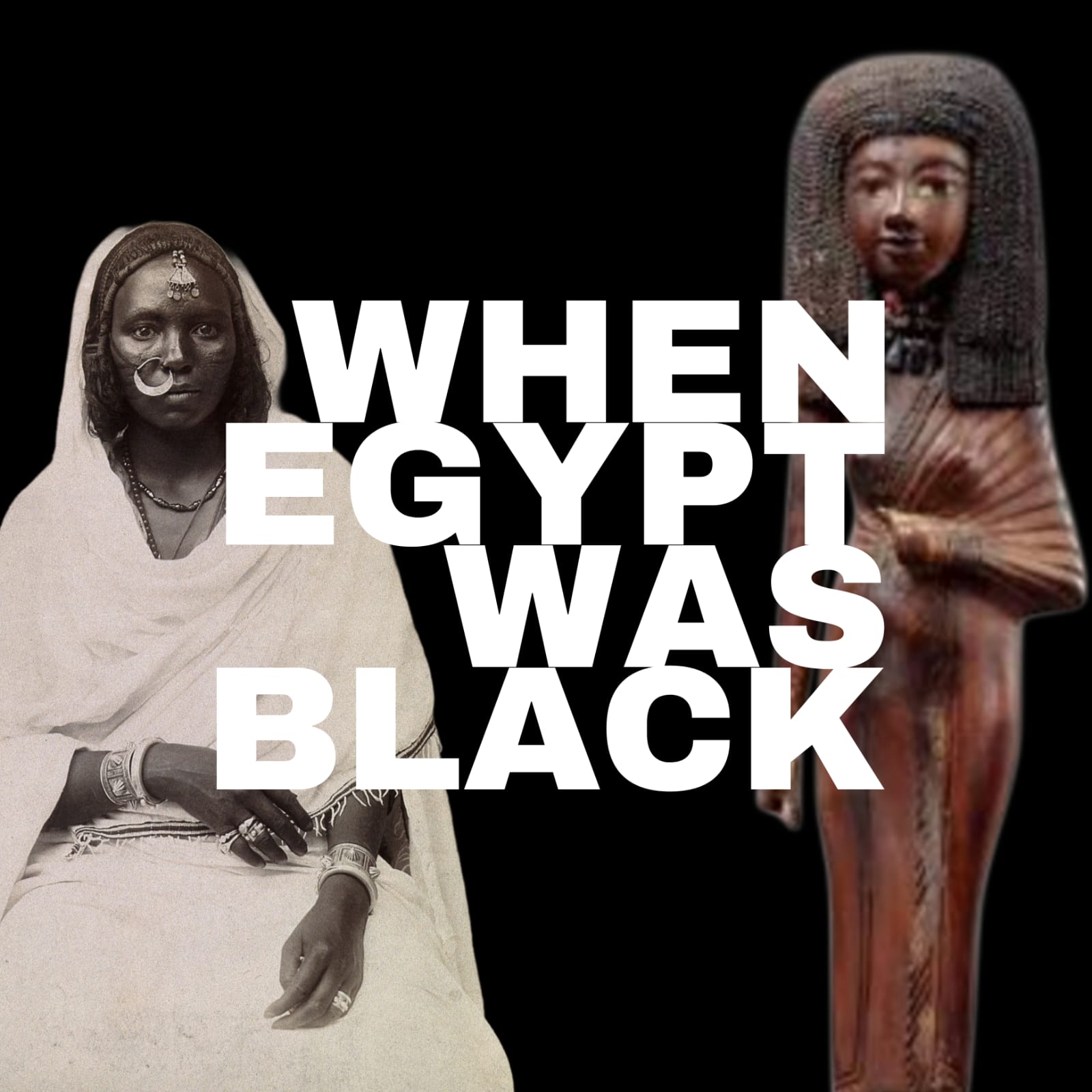
100 years ago Egypt was a completely different nation in contrast to the bustling metropolis cities that have become synonymous with this now Arab nation that is dependent on its tourist-fuelled economy. Back in 1925, however, we see an Egypt still steeped in the embers of ancient traditions, with the true descendants of the Kemetic culture still practising an ancient lifestyle in the same way 4,000 years after these practices were first etched in stone, in this beautiful footage captured by the Metropolitan Museum of Art, prior to the explosion of global interest in ancient Egypt and subsequent urbanisation of Cairo and Alexandria.


Much of the ancient Egyptian culture was under the custody of those indigenous southernmost Egyptians. Typical villagers are these aging patriarchs, although many generations removed. It is possible that the blood of the Pharaoh still courses the veins of these dark-skinned natives of this land of antiquity.

Those black African Egyptians who are today called the Nubian Egyptians were in those days not restricted to, as one modern Nubians state, that in these times the dark-skinned or black Egyptians never refer to themselves as Nubians, but sadly, much like the wider global melanated populations, they have had this label thrust upon them by those desperate to benefit from this modern economic caste system. Indeed, they remain distinct from the urbanised melting pot populations, their notable Africanity, which is expressed in their pastoralist cultural practices and a local penchant for adorning themselves in gold. This was punctuated by their continuation of Nile Valley practices that weren’t reflected by the non-Kemetic population as one draws toward the Delta region and Alexandria.
In this remarkable footage captured nearly one century ago, you will observe the undeniable preservation and continuation of ancient Egyptian tradition by its indigenous African population, who are in modern times known as the Nubians.
Indigenous Identity, Dress and Cultural Continuity


One of the most observable cultural differences between the ancient and modern Kemetic populations is the attire. More than just the influence of Islam, it seems the increasing desertification of the region has influenced the native Egyptians to lean towards a more Sahelian Saharan dress code that is reflected in many native African Saharan dwelling groups. In fact, the native African Egyptians are almost indistinguishable from their nomadic African neighbours, the Tubu, who reside in Libya or Sudan, donning similar thobes and turbans as a means to manage their desert climate. Perhaps this adjustment was equally a climatic as it was socio-religious adjustment.


According to tradition, prior to the flooding of the Nubian Plains, the population relied on the annual inundations of the Nile for subsistence. This is proven by scenes from the 1925 footage, which shows an unbroken dependence on the Nile Valley’s rich soil for sustenance and a deep cultural connection to the land surrounding the Nile.


The introduction of the camel into daily agricultural life is also a post-dynastic adjustment, one likely influenced by the migration and infusion of nomadic groups from the East, such as the Beja. These desert-adjusted beasts of burden inevitably became too practical to forsake.
Mud-Brick Architecture and Sustainable Building


The mud brick architecture that has cultural continuity in modern Nubian was employed extensively and universally in ancient Egypt. However, the non-Nubian populations of Egypt remained oblivious to these ancient architectural techniques. This practice, like all remnants of ancient Egyptian culture, was a Nubian practice, likely viewed as a primitive African behaviour, but the native African Egyptians never stopped using these techniques in more recent times.


But to put it bluntly, he naturalised indigenous “Nubian” architectural style and techniques into the largely non native, heterogeneous metropolitan Egypt.


The wider Egyptian populace began to adopt these building techniques when they learned that, far from being primitive, this architectural method is sustainable and tropically optimised. According to Virginia Emory, mud brick structures offered better interior climate control than equivalent stone structures, providing more comfortable living and working spaces. Mud brick construction was easily modified and expanded upon, allowing for the allocation of space and the adaptation of spatial arrangements in a fashion that stone could not accommodate.


The esteemed Egyptian architect and developer Hassan Fathy, who revived sustainable mud brick architecture across wider Egypt, did so only after being trained by Nubians. In the process of this sustainable building technique, the native African Egyptians had preserved this African building technique unbroken for at least 8,000 years, when we have first evidence of such buildings in ancient Nubia.
Traditional Nile-Valley Life and Water Management


Living in harmony with the Nilotic ecosystem, locals utilised an ancient tool called the shaduf to raise water. This simple mechanism, used since Pharaonic times, consisting of a bucket attached to a rope at the long end of a wooden pole resting on a fulcrum with a counterweight, was often used, but not at the exclusion of the more simplistic act of bailing water, as demonstrated by these Nubian women. The sustainable nature of the native people is reflected in their use of readily available materials, which kept the shaduf practical and in balance with their ancient homeland.
Displacement and the Struggle over Cultural Ownership


The Nubians have always prided themselves on the permanence of their society, which makes their current expulsion from the Nile Valley due to the flooding of the Nubian Plains all the more heartbreaking. Before their homelands were flooded and Egypt’s expanding migrant population forced and concentrated the Nubian population south to Aswan and Sudan, during the time in which this video was recorded, there seemed to be a unanimous acceptance of the African ownership of the ancient Egyptian culture.


This trend has changed recently with the rising international interest in tourism. This increasing dependency on the once shunned ancient Egyptian culture has prompted a shameful shift in rhetoric, expressed in a push by many modern Egyptians to usurp the cultural ownership of ancient Egypt and actively deny any connection to this culture as belonging to the indigenous dark-skinned Nubians. This unfortunate behaviour is being taken up by many of the youth, born out of ignorance of Egypt’s true history. But as with the very statues and artefacts, the evidence is here in black and white for the world to see that ancient Egypt is almost exclusively reflected in Egypt’s native melanated African population in both appearance and culture.
Cinema, Historical Memory and the Erasure of Nubian Heritage


Hollywood and global cinema have played a significant role in shaping perceptions of ancient Egypt. Films like Cleopatra, The Mummy, The Prince of Egypt and Gods of Egypt continue to significantly influence how people view ancient Egypt, often blending historical facts with modern politics, fiction and fantasy.


These portrayals, while entertaining, often alter the perception of the ancient Egyptian population in the minds of the general public. This, in turn, has greatly affected the behaviour of the modern citizens of the region, who attempt to carve modern paradigms of caste and racialism and falsely manipulate them into an ancient context.
Interestingly, what the 1925 Egyptian footage proves is that, prior to this rise in Egyptomania, the non-Nubian population had very little interest in or knowledge of the ancient Egyptian culture as a whole.
This is a stark contrast to the modern Egyptian population, who like to call themselves Pharaohs, often at the total exclusion of the Nubian population, as though there has been some kind of unbroken cultural continuity, when it is apparent to all that the reverse is true. Ironically, this is something that is only true for the Nubian population, the indigenous Nile-dwelling Africans.
Indeed, the removal of the native indigenous Egyptians, or Nubians, from modern Egyptian discourse has created a cultural gulf. This footage proves that no true link to ancient Egypt can exist without them.
Because of their refusal to acknowledge this, the modern population has become entirely dependent on Western scholarship to interpret Kemetic culture, having sadly evicted the true custodians of this knowledge.


As we observe of the Nubian caste being the sole preservers of all ancient Egyptian traditions, it is saddening that these same people, whose rituals brought so much joy, mystique, authenticity and unity to Egypt, are now the subject of so much Arab Egyptian scorn.
The authorities persecute, deride and ostracise this community, and many young Egyptians, rather than respecting and revering them as a living link to the ancients, claim they do not even exist and that Egyptians, although multicultural, were never Black to begin with. A bizarre and contradictory claim.
Thankfully, though,the 1925 footage serves as a hallmark, a punctuation mark in history, providing an immortal exhibit of evidence that none of these claims are true.
Let us not forget, but share and circulate this footage, hopefully forcing the world into open discourse. This video evidence must be remembered and highlighted so that the denial of their existence and the ignorance of their ongoing plea to return to the Nile do not continue for another 100 years.
Perhaps this write-up can serve as a reminder of the natural order, a time when the Egyptian population celebrated their mysterious indigenous Nubian countrymen and appreciated the vital connection to ancient Egyptian life this culturally African population provided.

The author, Andrew A. King BSc PGCE QTS is a qualified educator, creator and thought leader who is playing a leading role in redefining the participation of indigenous Africans in the development of the history of Black people in global history.

Leave a Reply